Created by: Lexi Little
For Grades: 1-3
Table of Contents
- Introduction
- A Letter to the Senate, Photo
- Petition for NWSA, Photo
- The First President Pin, Photo
- Appeal to the 16th Amendment, Photo
- Petition to the President, Photo
- Women’s Suffrage Procession Program, Photo
- Teaching Resources
Introduction
The Women’s Suffrage Movement originally started as the fight for women’s right to vote. It is a very important part of women’s history and will continue to be a resource for people to learn about women’s rights for eternity. The movement began in the late 19th century and continued into the 20th century. Though the movement helped them achieve some more basic rights for women, we still continue to fight today for more equality between men and women. As the movement grew, many women became trailblazers for themselves and other women in America. Susan B. Anthony and Elizabeth Cady Stanton started the National Woman Suffrage Association (NWSA). They wrote many petitions, letters, and requests to the US government. They organized rallies, marches, and protests to push their movement forward. Along with the NWSA, there was an organization called the National Association of Colored Women Club (NACW). This organization was founded by Mary Church Terrell, Ida B. Wells, Harriet Tubman, and Frances Ellen Watkins Harper. Though women of color were not welcome to join the NWSA at first, they decided they wanted to make their voices heard no matter what, so they created their own organization. Eventually, with all of the work each person put into the movement, the US government passed the 19th Amendment, giving women the right to vote. But, they knew it could not stop there.
I chose this topic because as a woman, I have experienced ways that we are treated differently from men in our society. Although I am going into the teaching profession, where women dominate the field, I still feel it is important to understand what women before us have done for us. I also feel like it is important to teach my students how people lived and were treated in the past.
1. A Letter to the Senate, Photo
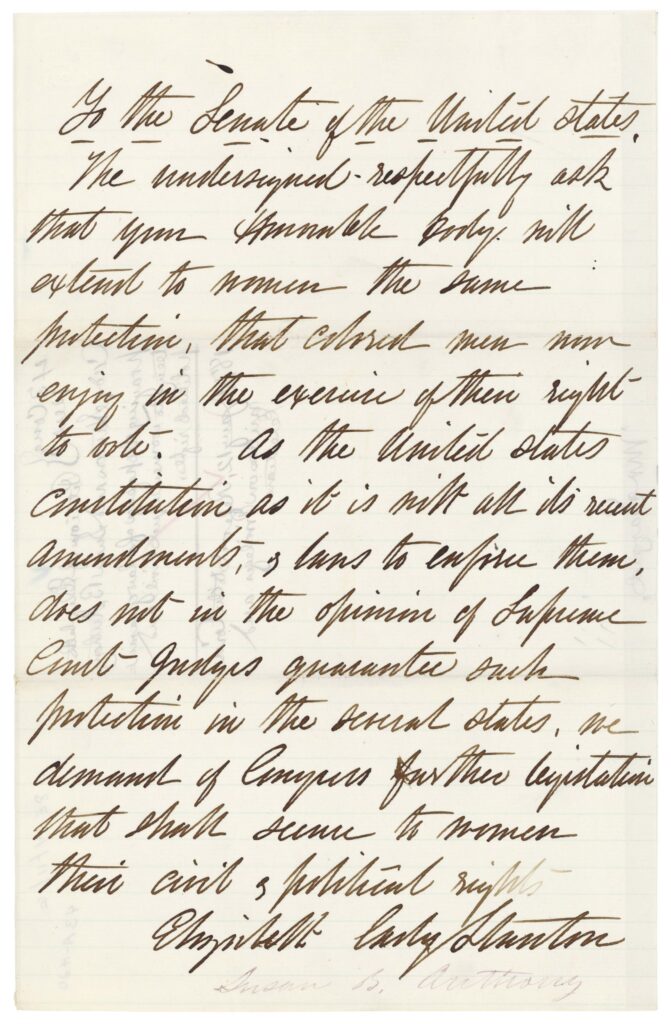
Record of the U.S. Senate
In this petition, Elizabeth Cady Stanton and Susan B. Anthony ask the Senate to extend the right to vote to women (though they were only advocating for white women’s rights) – “the same protection that colored men now enjoy.” (since 1870)
Transcript:
To the Senate of the United States.
The undersigned respectfully ask that your Honorable Body will extend to women the same protection that colored men now enjoy in the exercise of their right to vote. As the United States Constitution as it is with all its recent Amendments, laws to ensure them, does not in the opinion of Supreme Court Judges guarantee such protection in the several states, we demand of Congress further legislation that shall secure to women their civil & political rights –
Elizabeth Cady Stanton
Susan B. Anthony
Questions
- Why do you think women were not always allowed to vote?
- How do you think women felt about not being able to vote? How do you think men felt about women not being able to vote?
- How important do you think it is for everyone to be allowed to vote?
2. A Petition for the NWSA, Photo
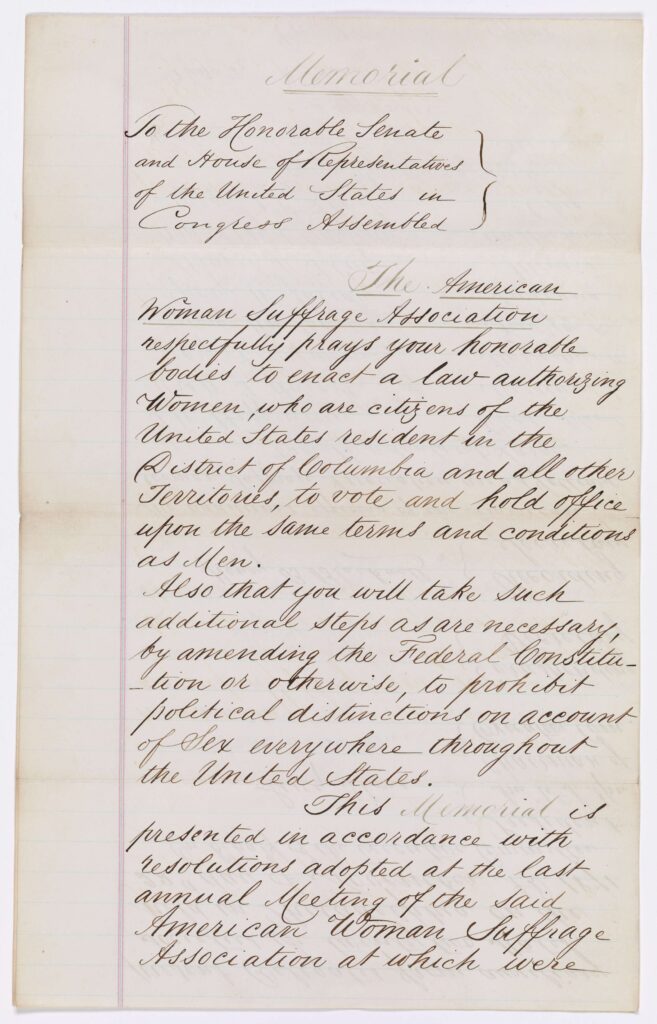
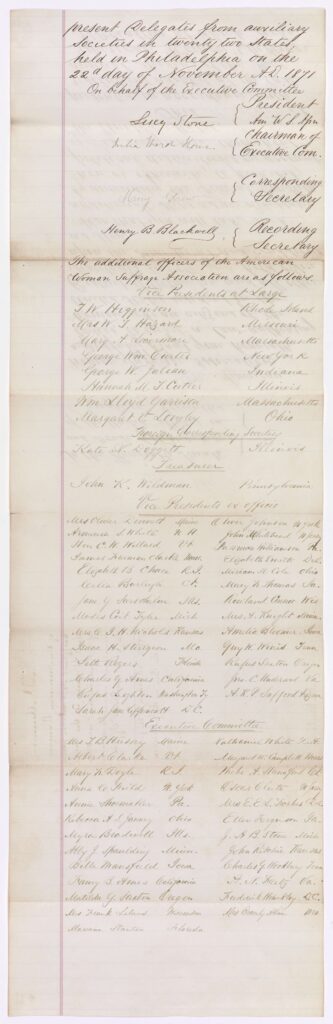
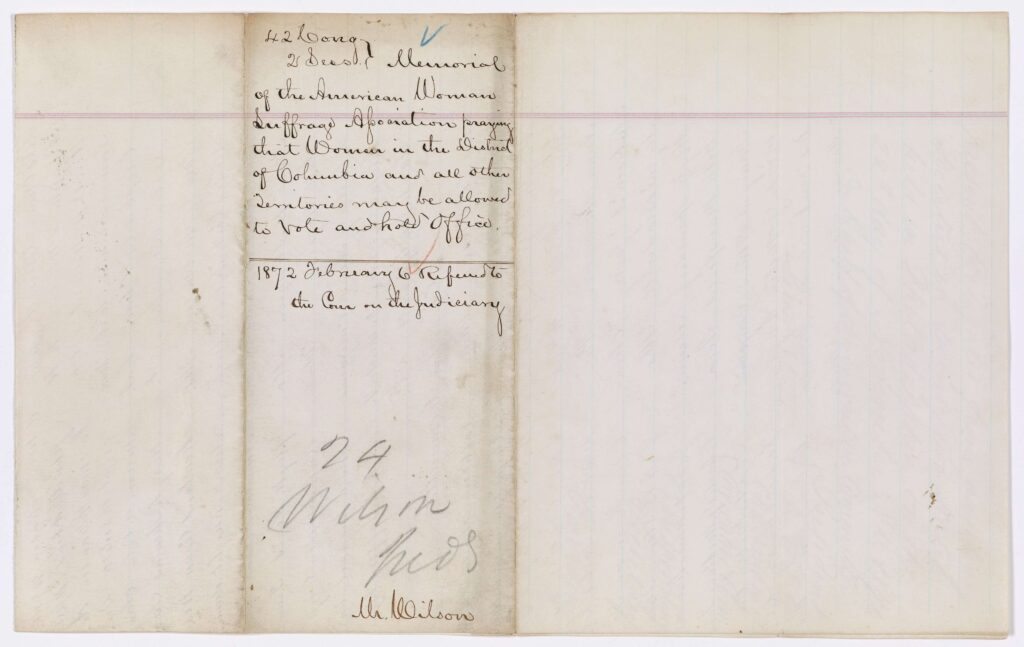
Records of the U.S. House of Representatives
This petition was signed by Susan B. Anthony, Matilda Joselyn Gage, and Elizabeth Cady Stanton of the National Woman Suffrage Association. They sent it to the U.S. Senate on January 20, 1873.
Questions
- Why do you think it is important for their movement to be recognized by the government?
- What is a constitution, and why is it important they made one for their organization?
- What do you notice about this document? What other questions do you have about it?
3. First President Pin, Photo
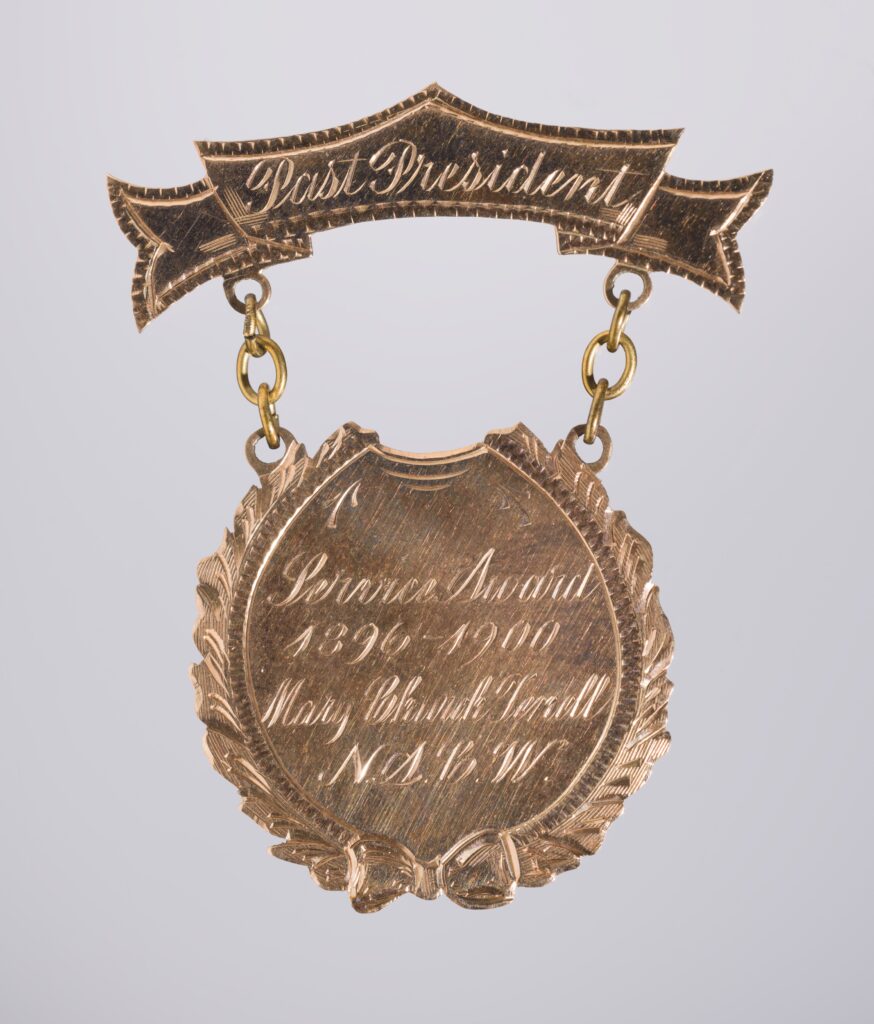
Smithsonian National Museum of African American Histpry and Culture
Pin award for Mary Church Terrell from the National Association of Colored Women’s Clubs (NACWC).
Questions
- Why do you think it is important for their movement to be recognized by the government?
- What is a constitution, and why is it important they made one for their organization?
- What organizations are you a part of, and how do you contribute to them? For example, Mary Church Terrell was the first president of the NACW, and Susan B. Anthony was the president of the NWSA. They also had vice presidents, an advisory committee, secretaries, and an executive committee.
4. Appeal to the 16th Amendment, Photo
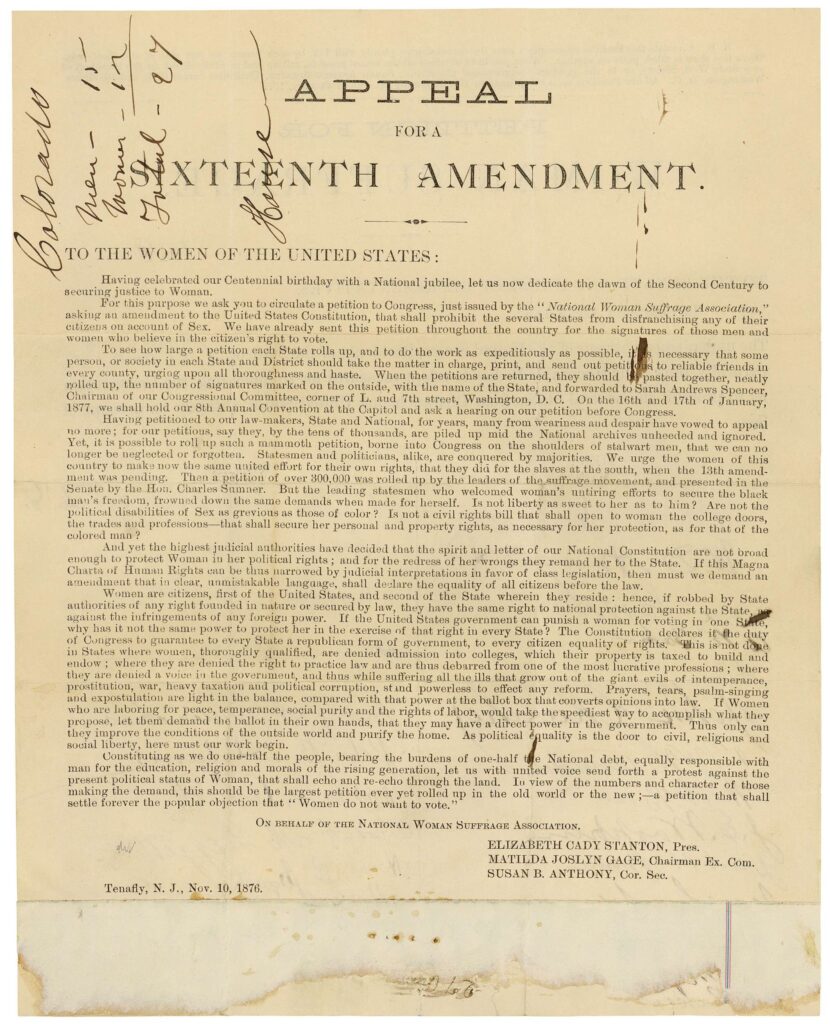
Rrecords of the U.S. House of Representatives
Susan B. Anthony and Elizabeth Cady Stanton signed this appeal, from the National Woman Suffrage Association. She wanted women to gather signatures and send them in to make “ the largest petition ever yet.”
Transcript:
TO THE WOMEN OF THE UNITED STATES:
Having celebrated our Centennial birthday with a National jubilee, let us now dedicate the dawn of the Second Century to securing justice to Woman.
For this purpose we ask you to circulate a petition to Congress, just issued by the “National Woman Suffrage Association,” asking an amendment to the United States Constitution, that shall prohibit the several States from disfranchising any of their citizens on account of Sex. We have already sent this petition throughout the country for the signatures of those men and women who believe in the citizen’s right to vote.
To see how large a petition each State rolls up, and to do the work as expeditiously as possible, it is necessary that some person, or society in each State and District should take the matter in charge, print, and send out petitions to reliable friends in every county, urging upon all thoroughness and haste. When the petitions are returned, they should be pasted together, neatly rolled up, the number of signatures marked on the outside, with the name of the State, and forwarded to Sarah Andrews Spencer, Chairman of our Congressional Committee, corner of L. and 7th street, Washington, D. C. On the 16th and 17th of January, 1877, we shall hold our 8th Annual Convention at the Capitol and ask a hearing on our petition before Congress.
Having petitioned to our law-makers, State and National, for years, many from weariness and despair have vowed to appeal no more; for our petitions, say they, by the tens of thousands, are piled up mid the National archives unheeded and ignored. Yet, it is possible to roll up such a mammoth petition, borne into Congress on the shoulders of stalwart men, that we can no longer be neglected or forgotten. Statesmen and politicians, alike, are conquered by majorities. We urge the women of this country to make now the same united effort for their own rights, that they did for the slaves at the south, when the 13th Amendment was pending. Then a petition of over 300,000 was rolled up by the leaders of the suffrage movement, and presented in the Senate by the Hon. Charles Sumner. But the leading statesmen who welcomed woman’s untiring efforts to secure the black man’s freedom, frowned down the same demands when made for herself. Is not liberty as sweet to her as to him? Are not the political disabilities of Sex is grevious as those of color? Is not a civil rights bill that shall open to woman the college doors, the trades and professions—that shall secure her personal and property rights, as necessary for her protection, as for that of the colored man?
And yet the highest judicial authorities have decided that the spirit and letter of our National Constitution are not broad enough to protect Woman in her political rights; and for the redress of her wrongs they remand her to the State. If this Magna Charta of Human Rights can be thus narrowed by judicial interpretations in favor of class legislation, then must we demand an amendment that in clear, unmistakable language, shall declare the equality of all citizens before the law.
Women are citizens, first of the United States, and second of the State wherein they reside: hence, if robbed by State authorities of any right founded in nature or secured by law, they have the same right to national protection against the State, as against the infringements of any foreign power. If the United States government can punish a woman for voting in one State, why has it not the same power to protect her in the exercise of that right in every State? The Constitution declares it the duty of Congress to guarantee to every State a republican form of government, to every citizen equality of rights. This is not done in States where women, thoroughly qualified, are denied admission into colleges, which their property is taxed to build and endow; where they are denied the right to practice law and are thus debarred from one of the most lucrative professions; where they are denied voice in the government, and thus while suffering all the ills that grow out of the giant evils of intemperance, prostitution, war, heavy taxation and political corruption, stand powerless to effect any reform. Prayers, tears, psalm-singing and expostulation are light in the balance, compared with that power at the ballot box that converts opinions into law. If Women who are laboring for peace, temperance, social purity and the rights of labor, would take the speediest way to accomplish what they propose, let them demand the ballot in their own hands, that they may have a direct power in the government. Thus only can they improve the conditions of the outside world and purify the home. As political equality is the door to civil, religious and social liberty, here must our work begin.
Constituting as we do one-half the people, bearing the burdens of one-half the National debt, equally responsible with man for the education, religion and morals of the rising generation, let us with united voice send forth a protest against the present political status of Woman, that shall echo and re-echo through the land. In view of the numbers and character of those making the demand, this should be the largest petition ever yet rolled up in the old world or the new;—a petition that shall settle forever the popular objection that “Women do not want to vote.”
On behalf of the National Woman Suffrage Association,
ELIZABETH CADY STANTON, Pres.
MATILDA JOSLYN GAGE, Chairman Ex. Com.
SUSAN B. ANTHONY, Cor. Sec.
Questions
- Is it fair for men to be able to get into college, but not women?
- What do you want to be when you grow up? How would you feel if you couldn’t have that job because of your gender?
- What would you do if you got this petition in the mail? Would you sign it?
5. Petition to the President, Photo
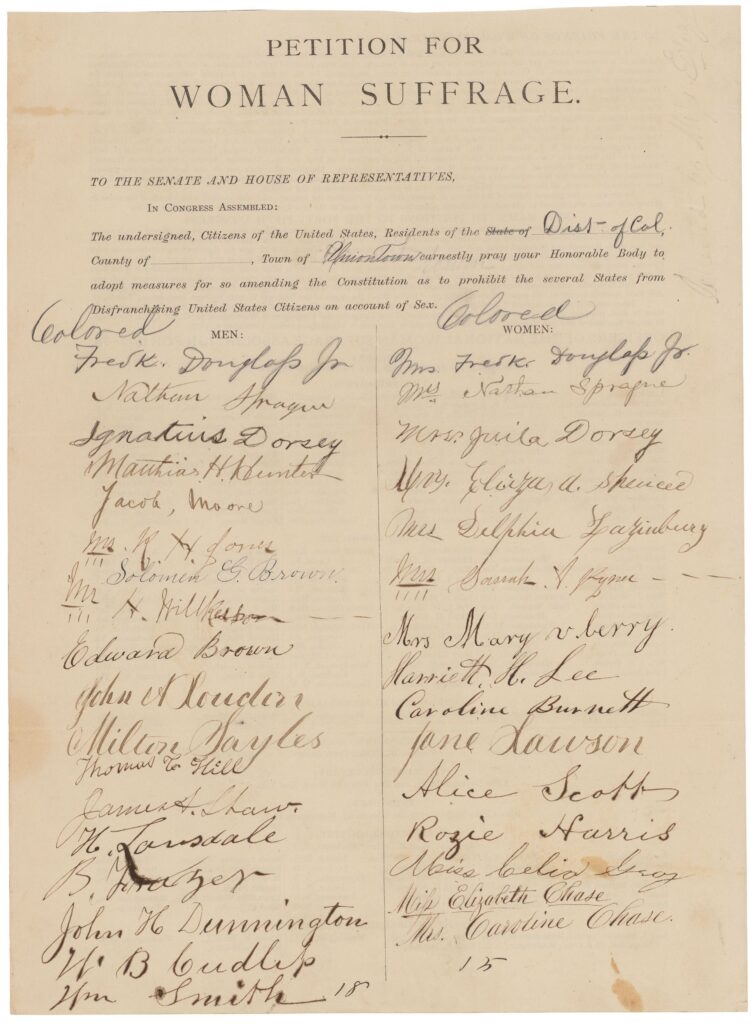
Records of the U.S. House of Representatives
Wealthy white women were not the only supporters of woman suffrage. Frederick Douglas, a formerly enslaved man and leader of the abolition movement, also supported women’s suffrage. In addition, a growing number of black women actively supported woman’s suffrage during this period. Prominent African-American suffragists included Ida B. Wells-Barnett of Chicago; Mary Church Terrell, educator and first president of the NACW; and Adella Hunt Logan, Tuskegee Institute faculty member, who insisted in articles in The Crisis, that if white women needed the vote to protect their rights, then black women – victims of racism as well as sexism – needed the ballot even more. This petition includes signatures of men and women of color that backed the Suffrage movement.
Questions
- Why is it important for not only women but men to also be actively involved in the Women’s Suffrage Movement?
- Do you think that any of these men got backlash for how they supported the movement?
- What is the significance of having men and women of color also sign the petition?
6. Women’s Suffrage Procession Program, Photo
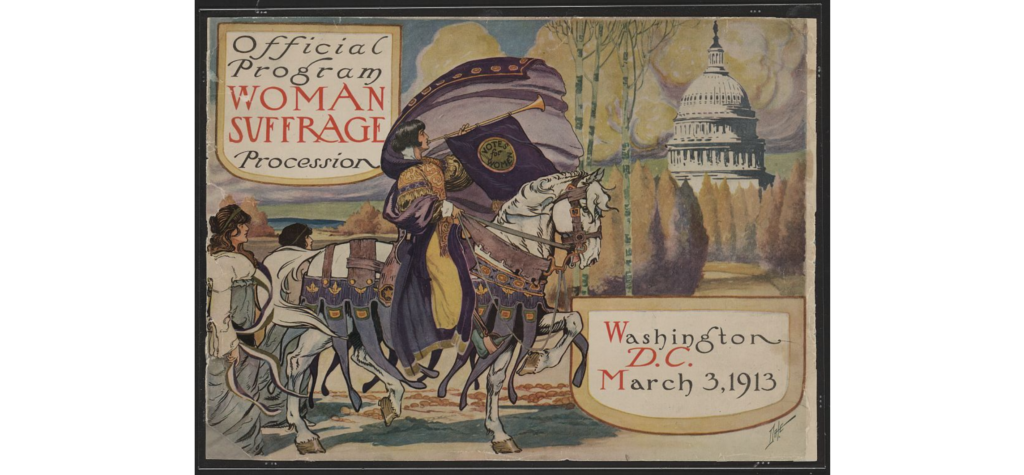
Library of Congress Prints and Photographs Division Washington D.C.
This is an advertisement for a march for Women’s Suffrage. It was made to attract people to support the cause. On March 3, 1913, more than 5,000 suffragists marched along Pennsylvania Avenue in Washington, DC. Despite some white women’s attempts to keep women of color out of the march, many—Ida B. Wells among them—attended. Among the marchers were 22 Black women from the newly formed Delta Sigma Theta sorority at Howard University. The parade was led by heralds on horseback, as depicted here, including suffragist Inez Milholland Boissevain. Many women were verbally and physically assaulted along the parade route while the police stood by, either unwilling or unable to control the crowd.
Questions
- Even though white women organizers of the march tried to keep women of color out, Black women still marched with them. Why do you think Black women still wanted to participate in the march?
- What about this picture sticks out to you, and why?
- What kinds of parades/marches/processions have you ever been involved in? What was your purpose of being there?
Teaching Resources
- Heart on Fire Susan B. Anthony Votes for President, by Ann Malaspina, illustrated by Steve James; https://www.albertwhitman.com/book/heart-on-fire/
- Ida B. Wells, Voice of Truth, by Michelle Duster, Illustrated by Laura Freeman; https://us.macmillan.com/books/9781250239464/idabwellsvoiceoftruth
- With Courage and Cloth: Winning the Fight for a Women’s Right to Vote by Ann Bausum; https://www.abebooks.com/9780792276470/Courage-Cloth-Winning-Fight-Womans-0792276477/plp
