Created by: Mónica Sánchez
For Grades: K-2
Table of Contents
- Introduction
- Pre-Colonial New Mexico – Sixth Day Mountain Chant, 1960-1979 (New Mexico Digital Collections)
- Spanish Colonialism with Indigenous People – Mission San Francisco de los Sumas, (c.1665) (Digital Public Library of America)
- Po’Pay – Pueblo Revolt -CliffFragua (Indian Pueblo Cultural Center)
- Spanish Colonialism – Painting (or drawing?) of ox carts being unloaded at the plaza in Santa Fe, New Mexico, ca.1910 (Digital Public Library of America)
- Mexican-American Territory Dispute – Mapa de los Estados Unidos de Mejico – Map of the United States of Mexico (New Mexico Digital Collections)
- New Mexico for Statehood -The Next Candidate for Statehood (New Mexico Digital Collections)
- Indigenous and US Relations –Indians Ask for Right to Purchase Land (New Mexico Digital Collection
- Chicano and American- Spanish American Folk Songs of New Mexico Unit No. 1 (New Mexico Digital Collections)
- Teaching Resources
Introduction
This is a very broad history of New Mexico. This holds the starting point for a very lost story about the complexities of New Mexico and the people it holds. Many people in the United States do not know the people and the number of contributions they had to the United States as well as their identity in the area. The people of this land and their story doesn’t really get a chance to get told. I begin from the start with pre-colonial era peoples and make my way by describing the colonialism or domination the Spanish have against the indigenous people. I also talk about the changes in borders and in the nature of where the land has gone. It’s important to acknowledge the indigenous groups that are present to this day and see how they have been treated by 2 layers of colonization. This also holds the complex nature of being mestizo/Chicano or half Indigenous and half Spanish. It talks briefly about the discrimination and racism of both in the US in language, culture, and statehood. This is liberatory in that it talks about the layers of colonization and helps kids visually see and understand the Southwest as not always being a part of America. It gives recognition to the state and its land rather than having people think it’s only Mexico. While this is only the start of this history. It tries to tell the very complex and culture-specific lives of the people that live there. Future investigations and primary sources will and should include the treatment of Chicanos, indigenous people, Chicano/Indigenous relations, and land treaties that contest or dispute the land between Indigenous groups, Spain, Mexico, and the United States. Future sources should also include the progress of language, culture, and well-being of present-day people.
1. Pre-Colonial New Mexico- Sixth Day Mountain Chant, 1960-1979 (New Mexico Digital Collections)
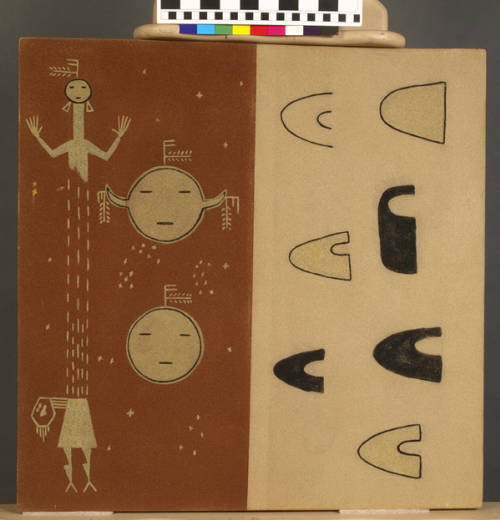
Leuppe, Álfred, [Painting image]. Sixth Day Mountain Chant, 1960-1979, New Mexico Digital Collections, accessed May 22, 2023, https://econtent.unm.edu/digital/collection/hubbard/id/785/rec/1
People from the Navajo tribe made art known as “sand painting” to tell stories or express their beliefs in God. These possible recreation paintings on an object show Father sun with white buffalo horns, it is the most powerful medicine chief of Father’s sky’s warriors. Second only to the great grandfather spirit mothers’ moon’s white princess. Sand painting was used as a healing ritual or ceremony. The Hataałi, traditional Navajo medicine men, would use colored grains of sand and pour them to make the paintings. It was believed that the sand paintings would provide healing and be able to remove illness from a person during the ritual.
Questions
- What do you notice about this picture?
- The description says that they used drawings to connect to God. Why do you think the Navajo painted these warriors? What story might they tell?
- There are buffalo horns on the Father Sun, why do you think animals are important to the Navajo people?
- Think about nature. the animals they use, and the materials they use. What is their importance and connection?
2. Spanish Colonialism with Indigenous People- Mission San Francisco de los Sumas, (c.1665) (Digital Public Library of America)
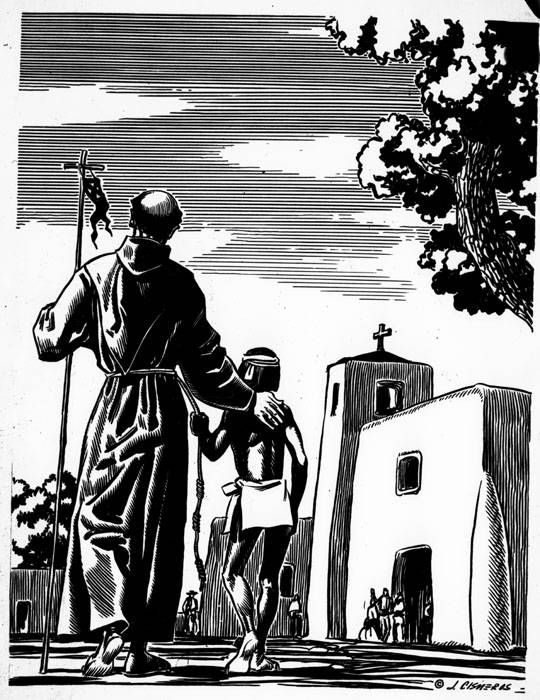
Cisneros, Jose, [Drawing image]. Mission San Francisco de los Sumas, Oral history transcript, c.1665, Digital Public Library of the Americas, accessed May 22, 2023, https://dp.la/item/0355683e1823519e4ba6806a0e7aa41b?q=Mission+San+Francisco+de+los+Sumas
This is a drawing of a Spanish missionary, a Catholic person sent on a mission to get people from other parts of the world to practice their religion. The missionary is walking with an indigenous person to a church called a Mission in Texas. Missions were built all around Texas, California, and New Mexico. The Spaniards colonized the Indigenous people which means, they forced them to drop their religious beliefs for Catholicism, forced them to build these missions, and forced women into marriages they did not want to be a part of. There is a population of people who are both of Spanish and Indigenous descent called Chicanos or Mexicanos. Not all indigenous people mixed, those that did try to stick to their indigenous roots and land.
Questions
- What do you see?
- What reactions are the Indigenous people giving to the Spanish missionaries? What differences are there in their clothing; what might that hint at?
- The second photo makes it look like the relationship between missionaries and indigenous people could have been equal. Look at the way that the missionary has their arm around the child. What type of idea is the photo trying to push?
- Let’s look at the Navajo art drawings. What’s different about the drawings that are different about these two photos? How are they different?
3. Po’Pay and the Pueblo Revolt
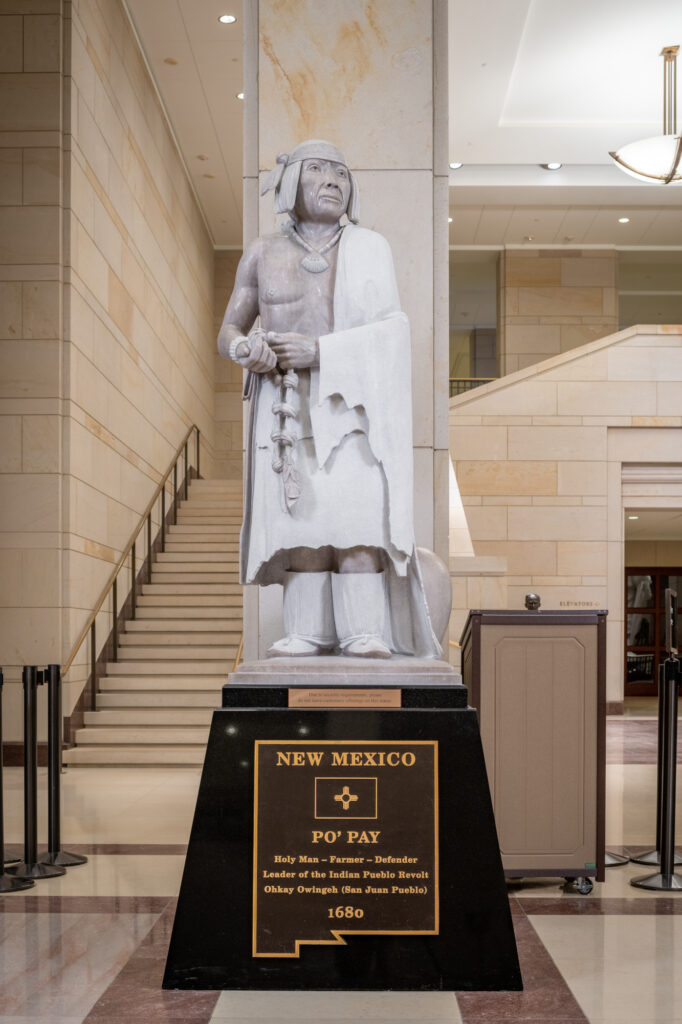
[Video] Fragua, Cliff (August 10, 2020). CliffFragua, Youtube. https://www.youtube.com/watch?v=d5aKI15VvI4
[Photo] (2005). Statue of Po'pay in the U.S. Capitol Visitor Center's Emancipation Hall. Architecht of the Capital. U.S. Capital Vistors Center. https://www.aoc.gov/explore-capitol-campus/art/popay-statue
This video is about an Indigenous man in the present day talking about a statue he makes of Po’Pay, an Indigenous leader who was able to overthrow the Spanish and the Indigenous people were able to have control of their land for 12 years until the Spanish returned and took over their land again.
Questions
- Why do you think it’s important to create a statue of this person?
- Why do you think the man did it now?
- What do you think is the relationship between the US and the Indigenous people? Is it positive? Is it ok?
- If this man is making this statue of someone from his history why do you think he made it?
4. Spanish Colonialism – Painting (or drawing?) of ox carts being unloaded at the plaza in Santa Fe, New Mexico, ca.1910 (Digital Public Library of America)
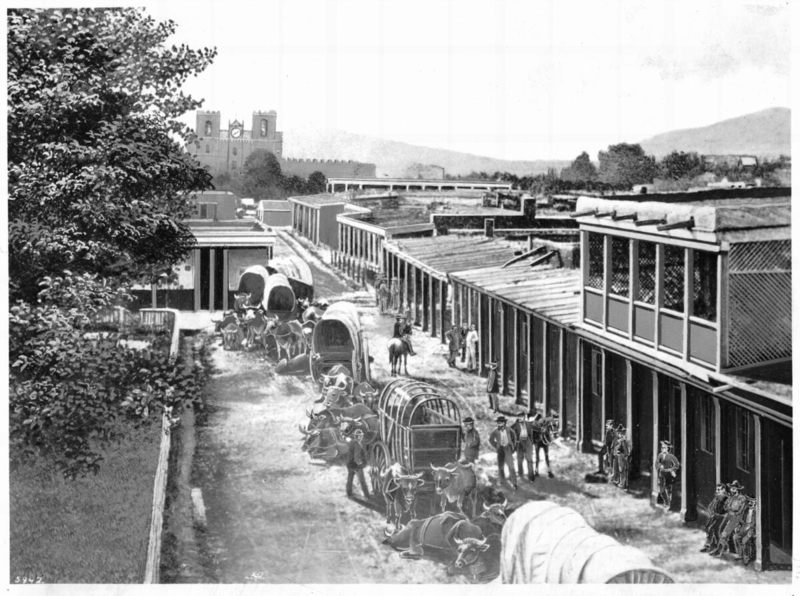
[Illustration Image]. Painting (or drawing?) of ox carts being unloaded at the plaza in Santa Fe, New Mexico, ca.1910, Digital Public Library of the Americas, accessed May 22, 2023, https://dp.la/item/ae458cbb5443de3078c556ffeb0fe373q=ox+carts+being+unloaded+at+the+plaza+in+Santa+Fe%2C+New+Mexico
This is an illustration of a square in Santa Fe, New Mexico of ox carts being unloaded at the plaza. All the way in the back there is a building that looks like a crown. That is a church. It is a very new church. The old church was burned down after the indigenous tribes of New Mexico banded together to destroy it because of the forceful oppression of Spanish colonies on indigenous groups. The Spanish built a newer church which is the one you see in this photo.
Questions
- What do you see here?
- Why do you think the Indigenous people burned down the church?
- Why do you think the church is so tall?
- How do you think this compares to indigenous homes?
5. Mexican-American Territory Dispute – Mapa de los Estados Unidos de Mejico 1847 – Map of the United States of Mexico (New Mexico Digital Collections)
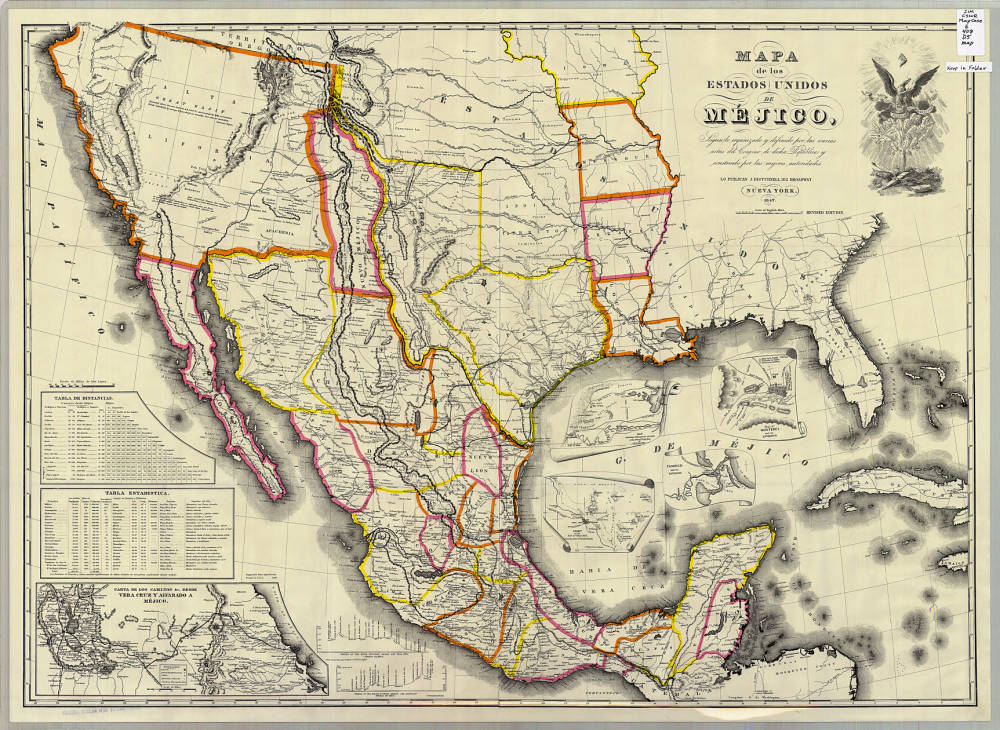
[Map Image]. Mapa de los Estados Unidos de Mejico, 1847, New Mexico Digital Collections, accessed May 22, 2023, https://econtent.unm.edu/digital/collection/Manuscripts/id/6790/rec/2
This is a map of Mexico. The mixed people of indigenous and Spanish descent decided it was time to end all ties to Spain and rule by themselves. Mexico will go to war with the United States over land and Mexico will eventually lose it.
Questions
- What areas do you see that actually are part of the United States?
- Make predictions. Using the knowledge you know about what the United States today looks like, how do you think the United States will treat the people that live in this land?
- How have borders changed over time?
6. New Mexico For Statehood- The Next Candidate for Statehood, 1901 (New Mexico Digital Collections)
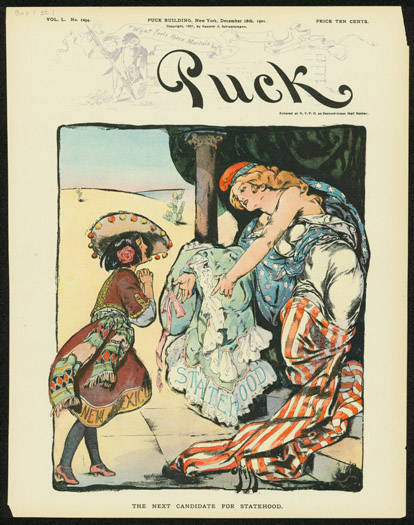
[Cartoon Commentary Image}. The Next Candidate for Statehood, 12/18/1901, New Mexico Digital Collections, accessed May 22, 2023, https://econtent.unm.edu/digital/collection/chavezgraph/id/70/rec/2
Since the land is now a part of the United States, there are Americans that move into the land. The original people of the land wanted to become a state.
Questions
- What do you notice about the little girl?
- What do you notice about the woman?
- Why do you think the little girl is holding her hands like that?
7. Indigenous and U.S. Relations – Indians Ask Right to Purchase Land, 1938 (New Mexico Digital Collection)
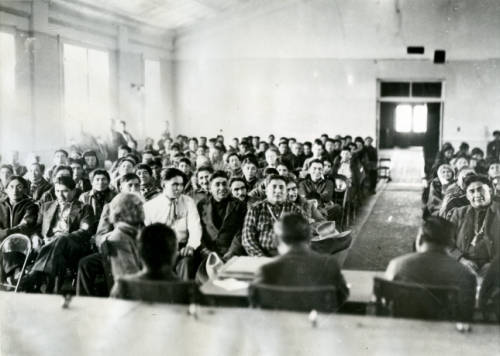
[Photograph] Indians Ask Right to Purchase Land, 01/01/1938, New Mexico Digital Collections, accessed May 22, 2023, https://econtent.unm.edu/digital/collection/locales/id/471/rec/1
Navajo people and mixed people of Spanish and Indigenous descent, called Chicanos, gathered to get the right to buy, with tribal funds, land next to the reservation in Western New Mexico from American settlers and Congress.
Questions
- What do you notice?
- What do you think the relationship between the indigenous people and the US government is like?
- Based on what you know about the indigenous people that live on this land, what is so weird about this situation?
- How do you think the US thought of the people on this land?
- What does this photo tell us about indigenous people fighting back?
8. Chicano & American – Spanish-American Folk Songs of New Mexico Unit No. 1, 1936-1937, (New Mexico Digital Collections)
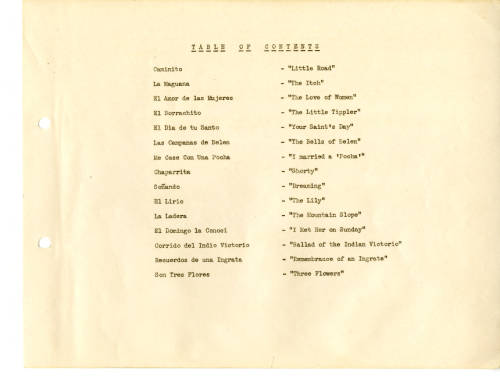
[Image Text] Ryan, Helen Chandler. Spanish American Folk Songs of New Mexico Unit No. 1. 1936-1937. New Mexico Digital Collections, accessed May 22, 2023, https://econtent.unm.edu/digital/collection/fmp/id/125/rec/2
These are Spanish-American songs from New Mexico. They are in English and Spanish. Chicanos were forced to speak English and abandon Spanish, especially in schools.
Questions
- Based on what you know about the history so far, why do you think the songs have to be in English?
- What layers do you see in the people of New Mexico?
- What kind of relationship do you think the mixed identities of New Mexico and the US have?
- Why could this be powerful to sing in Spanish?
- Based on what you know, what do you think the people of New Mexico grapple with? What’s complicated about the identities?
Teaching Resource
- Arrow to the Sun: A Pueblo Indian Tale https://www.indianpueblostore.com/collections/childrens-books/products/arrow-to-the-sun-a-pueblo-indian-tale
- Children of Native America Today https://www.indianpueblostore.com/collections/childrens-books/products/children-of-native-america-today
- American Girl – Josefina Series https://www.goodreads.com/series/53794-american-girl-josefina
- The Farolitos of Christmas – Rudolfo Anaya https://www.goodreads.com/en/book/show/1291898
- Colors of Navajo – Emily Abbinkhttps://lernerbooks.com/shop/show/11164
- Bless Me Ultima – Rudolfo Anayahttps://www.goodreads.com/en/book/show/14362
- The Night of Las Posadas – Tomie dePaola https://www.penguinrandomhouse.com/books/355386/the-night-of-las-posadas-by-tomie-depaola-illustrated-by-tomie-depaola/
- The Pueblo Revolt: The Rebellion that Drove the Spaniards out of the Southwest – David Robertshttps://www.simonandschuster.com/books/The-Pueblo-Revolt/David-Roberts/9780743255172
- Navajo Coyote Tales – Translated by Robert W. Young Compiled by William Morgan https://books.google.com/books/about/Navajo_Coyote_Tales.html?id=KxzwzgEACAAJ&source=kp_book_description
