Grades: 1-3
Content Warning: Mentions of racism, segregation, violence, and police presence.
Introduction
The topic explored in this journey box is Ruby Bridges and her experience being the first African American child to desegregate an all White school in the south, in 1960. Ruby paved the way for other African American children to attend schools with White children across the South. She had to walk past angry and violent protestors in order to enter. The topic is explored through various images, an interview with Ruby Bridges, and newspaper articles. The journey box also explores the Brown v. Board of Education decision and the geography of the events that occur before and during the beginning of integrating schools in the American South. The southern states required segregation before The Brown v. Board of Education decision was made. The segregation of schools was decided to be a violation of the 14th amendment. Segregation violated the equal protection clause of the 14th amendment, because the Black only schools lacked necessities for students to learn and do their best. Even though the Brown decision said that students were to be integrated together based on race, the southern states and many communities across the United States were slow to change or change at all. Some communities and school districts across the United States are considered segregated to this day, due to White families sending their children to private schools or moving to less integrated communities. My intent in exploring Ruby Bridges, school segregation, and desegregation, is to expose the inequities faced by African American children in the American education system before and during the Civil Rights Movement era. The Journey box explores the perspective of a young African American girl, Ruby Bridges, in paving the way for educational reform.
The journey box is a liberatory counter narrative, as it explores the topic of school desegregation from a young African American girl’s first hand experience. Through her perspective, the audience can gain a better understanding and empathy for the African American child’s educational experience in the American South, during the Civil Rights Movement era. The journey box suggested grade levels are first through third. I believe grades 1-3 would be able to connect with Ruby Bridges’ story and could make connections to her feelings and experiences.
Table of Contents
- RR Moton High School Photos and Farmville School Photos
- Conclusion of Brown v. Board of Education Decision Article
- Issue Warning On Lawless Acts In Integration Fight Article
- Ruby Bridges Being Escorted to School by U.S. Marshalls Photo
- Crowd Protesting School Integration Photo
- Photo of Ruby Bridges and Her Teacher Barbara Henry
- Ruby Bridges With New Classmates Photo
- Ruby Bridges Remembers Interview
- Children’s Literature
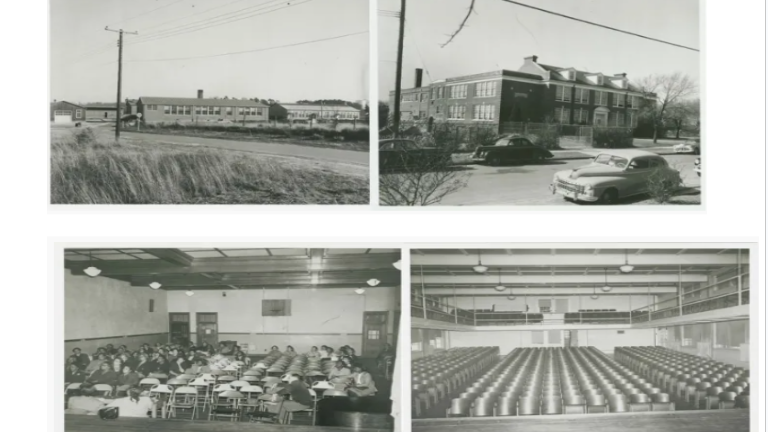
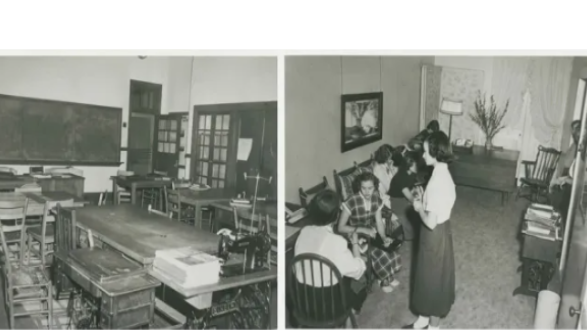
1. R.R. Moton High School pictures on the left, an all Black school in Virginia, and Farmville school pictures on the right, an all White school in Virginia 1951.
(Children’s Museum Indianapolis)
The school on the left is called R.R. Moton High School, and was a segregated school for Black children around 1951. The school on the right, is an all White segregated school called Farmville schools. During the Brown v. Board of Education case, the pictures of the R.R. Moton High School were presented during court, and contributed to the decision to make segregation illegal across the United States.
Questions
- How are the images on the left different from the images on the right? Compare and Contrast.
- Why do you think the schools look different? What could be a reason for this difference?
- Have you observed any differences between schools in your own city/ town? What kind of differences did you observe?
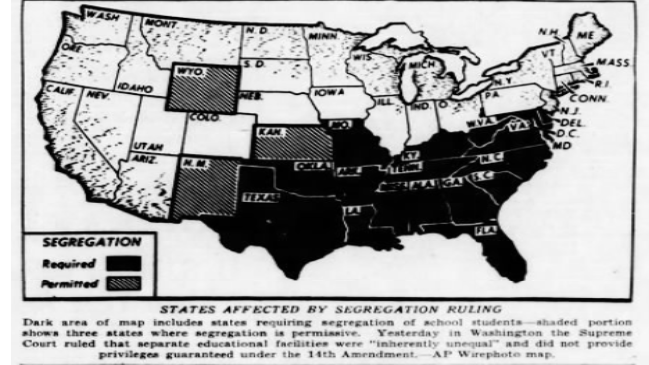
2. Conclusion of Brown v. Board of Education Decision 1954.
(Cincinnati Enquirer, Cincinnati, Ohio, Newspapers.com)
The map above shows where segregation was required and permitted in the United States before The Brown v. The Board of Education decision was made. The states shaded in the darkest color were legally required to enforce segregation in their public schools. The states shaded in the lighter color allowed each school district to decide if their schools would be segregated. The states without shading did not legally enforce segregation. Segregation required meant that all of the school districts were to keep students separate based on race in their schools. Segregation permitted meant that the school districts in that state had the option to keep students separate based on race. The caption states the following, “Yesterday in Washington, the Supreme Court ruled that separate educational facilities were ‘inherently unequal’ and did not provide privileges guaranteed under the 14th Amendment.”
Questions
- Find the state you live in now. Was school segregation required before the Brown decision in your state?
- How might segregation permitted and segregation required schools be different from one another?
- Do you think segregation happened in the northern states and western states even though it was not required or permitted?
3. Issue Warning On Lawless Acts In Integration Fight, December 10th, 1960.

(The Sheboygan Press, Sheboygan, Wisconsin).
During the weeks before and during Ruby Bridges’ attendance at William Frantz Elementary School in New Orleans, Louisiana, there were violent threats coming from the White families who were wanting the school to stay segregated. Some of the White segregationists were calling the families who wanted to send their children to a desegregated school, and threatened to harm them over the phone. Some of the White parents who were supporting the desegregation of William Frantz Elementary School had their tires slashed, windows smashed, and were told by the segregationists that they were going to “get” them. The police Chief Joseph L. Giarrusso warned that he will be putting a stop to the threats from segregationists. The governor of Louisiana, Jimmie Davis, told the segregationists to “stand fast” and not “break ranks.” To “stand fast” and not “break ranks” means to not give up and stick together with other people who also believe as you do.
Questions
- How do you think the White families who are in support of school desegregation will react after the treatment they have received from the White segregationists?
- The White families who are supporting the desegregation of William Frantz Elementary School are being threatened by segregationists. How do you think Ruby Bridges, a Black girl, will be approached by the segregationists when she goes to the school on her first day?
- In the newspaper article, the Louisiana Governor Jimmie Davis tells the segregationists to “stand fast and not break ranks.” What does this tell us about Governor Jimmie Davis’ viewpoint on segregation?
4. Ruby Bridges Being Escorted to School by U.S. Marshalls November 14th, 1960.

(DocsTeach)
The U.S. Marshals escorted Ruby Bridges during her first day at William Frantz Elementary School due to the violent protests within the local White community, and threats to harm Ruby. The names of the two U.S. Marshals are Charlie Burks and Brian Teston.
Questions
- How do you think Ruby feels in this picture?
- What do you think Ruby’s school day will be like?
- If you were in Ruby’s position, what would make you feel safe?
5. Crowd Protesting School Integration, November 14th, 1960

(Website: NPR and the Associate Press)
NPR and the Associate Press, November 11, 2020, Lucille Bridges, Mother of Anti-Segregation Icon Ruby Bridges, Dies
At 86, NPR, April 15, 2023, https://www.npr.org/2020/11/11/933854762/lucille-bridges-mother-of-anti-segregation-icon-ruby-bridges-dies-at-86
A crowd gathered outside the William Frantz Elementary School in New Orleans on Monday, Nov. 14th, 1960, protesting the integration of the school. The school had previously been an all White school, and continued to stay a segregated school six years after the Brown v. Board of Education case outlawed segregation in schools in 1954. This was the first day of classes for six year- old Black student Ruby Bridges, and the first attempt to integrate a school that was historically segregated based on race in the South.
Questions
- What do you notice about the crowd of people? What do they look like and what do their signs say?
- If a crowd was protesting your first day of first grade, how would you feel? Would you want to go to school?
- Why might these White boys want their community’s schools to stay segregated?
6.Photo of Ruby Bridges and Her Teacher Barbara Henry, November, 1960

(Social Studies for Kids) https://socialstudiesforkids.com/articles/ushistory/rubybridges.htm
During Ruby Bridges’ first year attending William Frantz Elementary School, she was the only student in her classroom with her teacher named Barbara Henry. The White parents who disagreed with the integration of the school, or who were afraid of the consequences by the segregationists, kept their White children home and would not send them to attend class with Ruby.
Questions
- What do you notice about the image?
- How do you think Ruby feels about being the only student in the classroom with her teacher?
- What do you think the white children who continued to attend William Frantz Elementary School learned about school integration when Ruby was kept separate from them within the school?
7. Ruby Bridges With New Classmates, 1960

(DocsTeach)
During Ruby’s first year at the school, her teacher Barbara Henry discovered four children in a classroom where a teacher had the radio playing during class. Barbara Henry asked the teacher if Ruby could join their class in the afternoons, and the teacher refused to teach Ruby. Barbara Henry asked the superintendent of the school if she could teach the four children and Ruby together. The superintendent approved Barbara Henry’s request to teach the four students and Ruby in the afternoons. Without the parents knowing, every afternoon for the rest of the school year, the four children would come in and learn with Ruby.
Questions
- What do you notice about the children in this photo?
- Do you think the children like being together?
- Why do you think the other teacher Barbara Henry talked to refused to teach Ruby?
- Do you think the students would have been together for this photo if their parents had been involved?
8. Ruby Bridges Remembers Interview, October 21st, 2010.
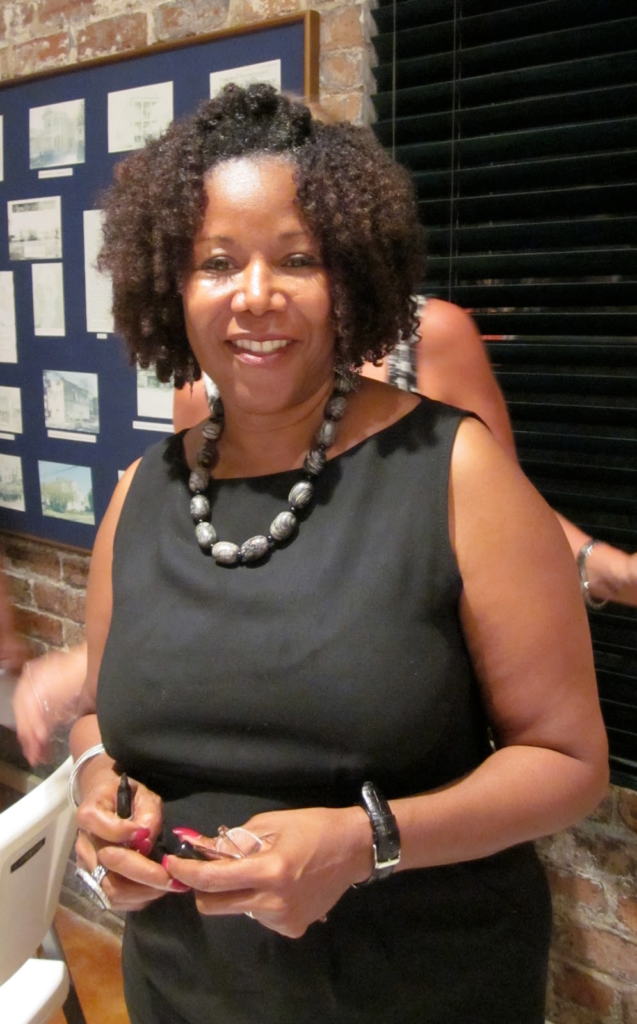
(Scholastic) Scholastic. (2010, Oct. 21st). Ruby Bridges Remembers.
Ruby Bridges is interviewed by a Kid Reporter named Abigayle Lista at the Ruby Bridges Foundation in New Orleans, Louisiana. Lista interviews Bridges about her experience as the first African- American student to attend William Franz Elementary School in New Orleans, Louisiana on November 15th, 1960.
Questions
- Ruby Bridges was not allowed to go to the cafeteria or the playground her first year at her new school. Why do you think she wasn’t allowed to go to the cafeteria or playground when she first began attending the all White school?
- How was Ruby’s school experience similar or different from your school experience?
- Ruby says how important it is for children to be able to connect with people who are different from themselves. In what ways are your friends or peers different from you? Explain.
- Ruby challenges children today to address racism and stand up for people who are treated unfairly. What are some examples of ways that you can stand up for people who are being treated unfairly in your daily life?
9. Children’s Literature
I am Ruby Bridges by Ruby Bridges Illustrated by Nikkolas Smith, https://shop.scholastic.com/parent-ecommerce/books/i-am-ruby-bridges-9781338753882.html
Through My Eyes by Ruby Bridges https://www.scholastic.ca/books/view/through-my-eyes
New Shoes by Susan L. Meyer Illustrated by Eric Velasquez https://holidayhouse.com/book/new-shoes/
If You Were a Kid During the Civil Rights Movement by Gwendolyn Hooks Illustrated by Kelly Kennedy https://shop.scholastic.com/teachers-ecommerce/teacher/books/if-you-were-a-kid-during-the-civil-rights-movement-9780531230985.html
The Other Side by Jacqueline Woodson Illustrated by E.B. Lewis https://www.penguinrandomhouseretail.com/book/?isbn=9780399231162
