Created by: Aaliyah Anderson
For Grades: 4-8
Table of Contents
- Introduction
- Bell Rack, [Graphic]
- Free and Slave Holding States [Map]
- Wildfire importing and exporting slaves [Newspaper]
- Memoir of Daniel Drayton and his imprisonment (for charity) for helping slaves [Book]
- Underground Railroad [Map]
- Slave ship showing how slaves were imported and exported in the 1800s [Photograph]
- Field Whip in the 1850s [Photograph]
- Branding Iron used on slaves [Photograph]
- Frederick Douglas 1818-1895 [Photograph]
- Reward Poster for Runaway Slaves in 1840 [Poster]
- Slavery Days Songs and Chorus Sung by Harrigan and Har of the 1800s [Music]
- Teacher Resources: A curated list of children’s literature about slavery
Introduction
This journey box goes through the period of time in which slavery was prevalent in the United States. It has events, tools, people, and places that are historically important to the United States of America’s history pertaining to the factual evidence of slavery. Slavery lasted for more than four hundred years in this country. It was a tragic period of time for African American people in the United States. If I could add more to my journeybox I would add more journals and personal letters written firsthand by enslaved people. My vision for this journey box is to give textual evidence and information for educators to be able to use in a school setting. I wanted to create something that was meaningful to my culture that could help students learn about hard history in an appropriate way. Black History is a common topic taught in schools but I wanted to create information specifically about slavery for educators to use. Slavery is not a specific topic that is often taught accurately or thoroughly in schools. For White educators, it is often a difficult topic to comfortably teach. It is important to educate yourself as an educator and use that information to accurately teach our students. It is liberatory to the mindset that slavery is a hard historical topic in the United States and is often not taught besides by curriculum-based textbooks. I intended for this content to be taught as early as a fourth-grade classroom and all the way throughout high school.
1. Bell Rack, [Graphic]

Russell, Mobile. Bell Rack. 1840, Graphic, Library of Congress, Washington, D.C., https://lccn.loc.gov/99615417. Accessed 09 April 2023.
Enslaved people would be required to wear this tortuous contraption if they tried to run away from their slave owners. Not every enslaver used this contraption but it was used by some. This heavy piece of metal was used basically like a dog collar so the slave owners knew when their slaves moved.
Questions
- What do you notice about this photo? Why might the photographer have a white man model something that is used on enslaved people?
- Why would it matter to the enslavers if the people they enslaved ran away?
- Why might the enslaved people want to run away?
2. Free and Slave Holding States [Map]
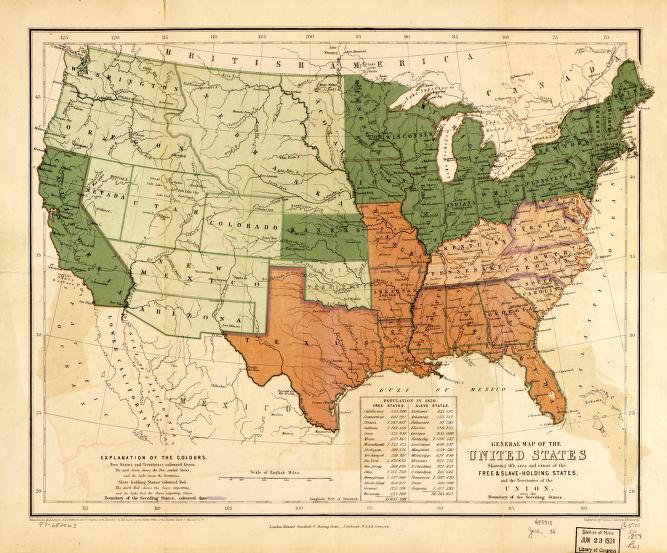
General map of the United States, showing the area and extent of the free & slave-holding states, and the territories of the Union: also the boundary of the seceding states; Map. London: E. Standford; Edinburgh: W. & A.K. Johnston, [1857]. Library of Congress, https://www.loc.gov/resource/g3701e.cw1020000/?r=0.04,0.405,0.826,0.444,0. Accessed 16 April 2023.
This is a map representing the slave and enslaved states in the United States in 1856. However, the map was not created until 1857. The map was created by a man named Edward Stanford and he was from London. He was a famous map artist in the 1800s. The Key at the bottom shows the representation for each state. It also shows the populations in each state during that time. It indicates slave states and free states.
Questions
- What do you notice about this specific map? Compare and contrast it to a map of the United States from today.
- What do you notice about the slave states and where they are located and why do you think it is like that?
- How does it make you feel looking at the population differences between the slave states and free states?
3. Wildfire importing and exporting slaves [Newspaper]
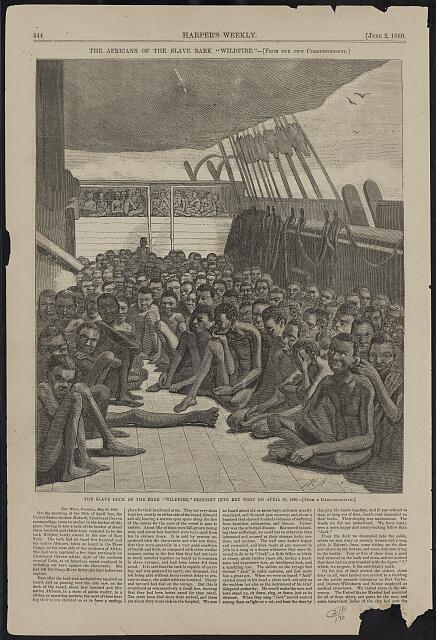
The Africans of the slave bark "Wildfire"- The slave deck of the bark "Wildfire," brought into Key West on April 30, 1860. 1860, Photograph, Library of Congress, Washington, D.C., https://www.loc.gov/item/98501624/. Accessed 16 April 2023.
This is an image showing the importation/exportation of enslaved humans. This is a photo showing enslaved men and women separated from the lower to the upper deck on a ship called the “Wildfire”. This ship was carrying these men and women to the Key West in 1860. The Key West is located in the Southwest area of Florida. In 1808 the importation of enslaved people was outlawed in America. However, for decades it was happening illegally. This photo was created by Harper’s Weekly, a political magazine company based in New York. The creator wanted to inform the United States government of what is going on in the South and for Southern states to know there are safe places helping enslaved people stay free.
Questions
- Why might men and women be separated if they are being bought and sold and used as property instead of acknowledging them as human beings?
- What do you notice about the enslaved men’s faces in this photo? Why is it important to understand that the artist created all the men in this photo to look the same?
- Do you think there is a reason why none of the enslaved people are wearing clothes?
4. Memoir of Daniel Drayton and his imprisonment (for charity) for helping slaves [Book]
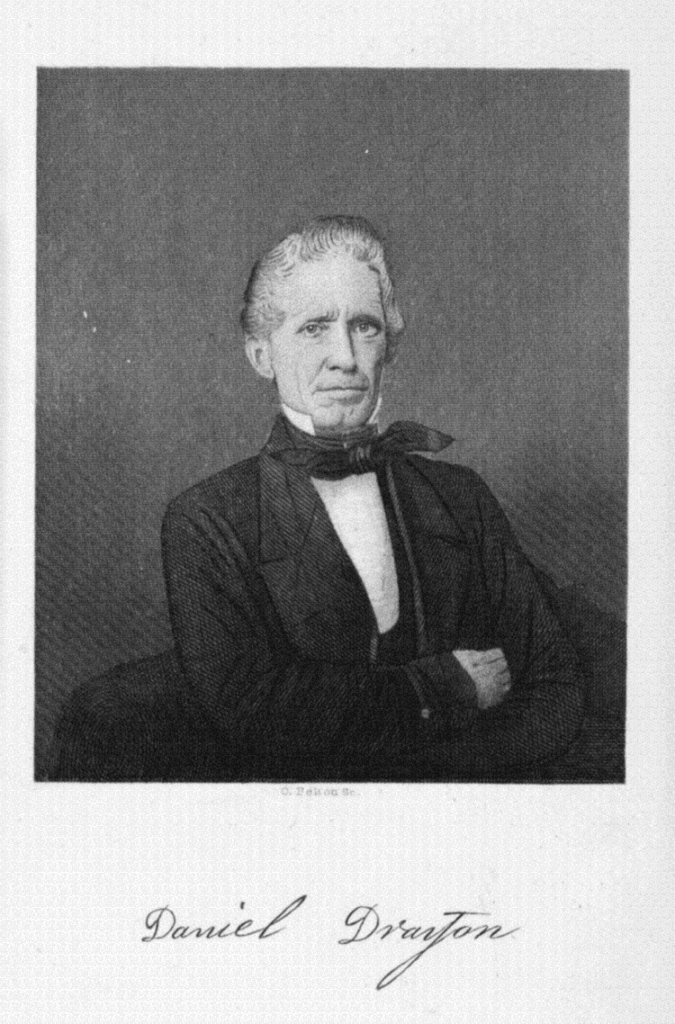
Drayton, Daniel. "Personal Memori of Daniel Drayton, for four years and four months a prisioner (for charity's sake) in Washington jail. Including a narrative of the voyage and capture of the schooner Pearl". 1855, Library of Congress, Washington, D.C., Typescript. Library of Congress. https://lccn.loc.gov/14019577. Accessed 02 May 2023.
This image is the front cover of a memoir of a man named Daniel Drayton who lived and was imprisoned in Washington, D.C. This man was someone who wanted to help enslaved people become emancipated and free during the 1800s. Washington D.C. was ceded by two slave-holding states Virginia and Maryland. Back in the 1840s The District of Columbia was made up of Georgetown, Washington City, Washington County, and Alexandria and was known as the center of the slave trade and slavery together.
Questions
- After reading and looking at this photo, why might some slaves find it hard to trust white people who say they are anti-slavery?
- Why would Daniel Drayton be sent to prison for helping enslaved people to freedom?
- Washington D.C. was made up of two slave-holding states. Why did this continue if surrounding states were free states?
5. Underground Railroad [Map]
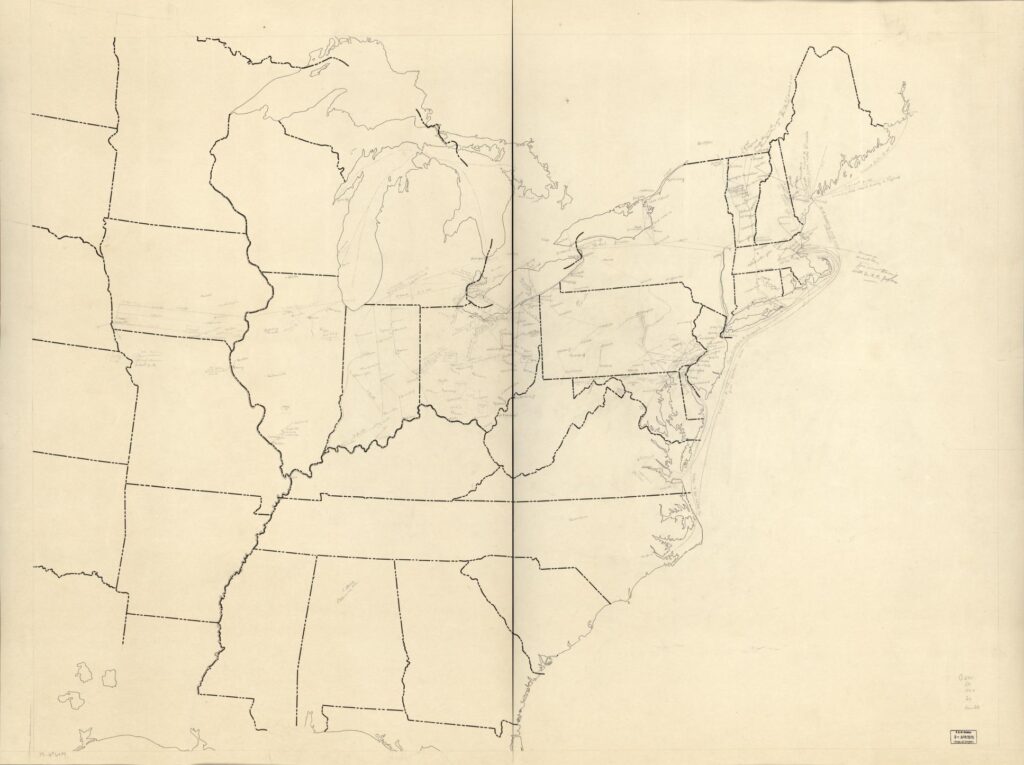
Federal Writers' Project. Underground Railroad map of the United States, ca. 1838-1860, Manuscript Map. Library of Congress, 1941. https://lccn.loc.gov/75696204. Accessed 02 May 2023.
Here is a map showing the underground railroad and the names of the towns it went to. The Underground Railroad was a collection of people white and black who helped shelter and hide enslaved people in order for them to get to a state that was free. The Underground Railroad was not actually a real railroad where you see trains. It was a safe route for freedom seeker Harriet Tubman was the most famous conductor of the Underground Railroad. It was very difficult and dangerous for enslaved people to run away to freedom if they were caught they would be beaten or sometimes worse, killed. It was also illegal for people to hide enslaved people or be an accomplice in their escape.
Questions
- How do you think this map was created if slaves often did not know how to read or write?
- Who is Harriet Tubman and why is she so significant to the underground railroad?
- Who do you think used this map?
- Can you find where you live? What do you notice about your region in relation to routes freedom-seekers used?
6. Harriet Tubman [Photograph]
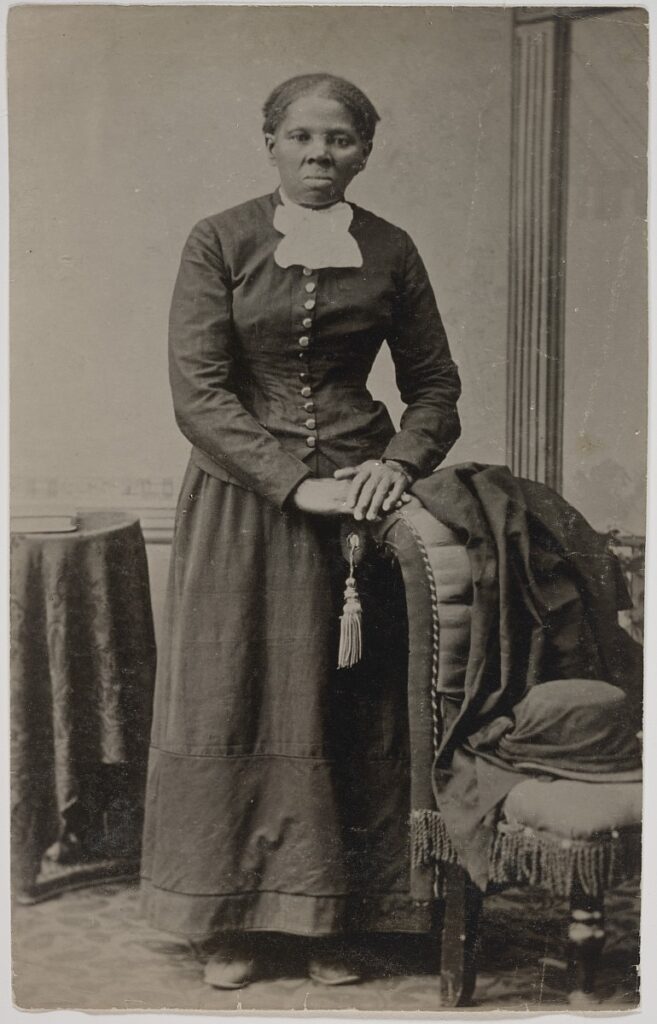
Lindsley, B. Harvey. Matte Collodion print of Harriet Tubman. 1871, Photograph, Smithsonian, America, https://www.si.edu/object/matte-collodion-print-harriet-tubman%3Anmaahc_2017.30.48. Accessed 03 May 2023.
This is Harriet Tubman and she was a very important and courageous person who helped conduct the Underground Railroad. She was born Araminta “Minty” Ross in Maryland around the 1820s. Both of her parents (Harriet “Rit ” Green and Ben Ross) were slaves and so were her and her nine siblings. She married a man in 1844, named John Tubman who was a free Black man. Alone she escaped Philadelphia in 1849. She conducted 13 dangerous trips to help other enslaved men and women get to freedom (this took over a decade). Her last mission was in 1860 saving around 70 people over this time period. She worked for the Union Army during the Civil War. In 1863 she became the first woman to lead an armed expedition in war and liberated more than seven-hundred slaves. She never learned to read or write. Harriet died in 1913.
Questions
- Without people like Harriet Tubman, how do you think the outcome of Slavery would have been different? Explain in detail.
- Why do you think Araminta changed her name to Harriet?
- What do you think the impact of Harriet marrying a free man was?
7. Slave ship showing how slaves were imported and exported in the 1800s [Photograph]
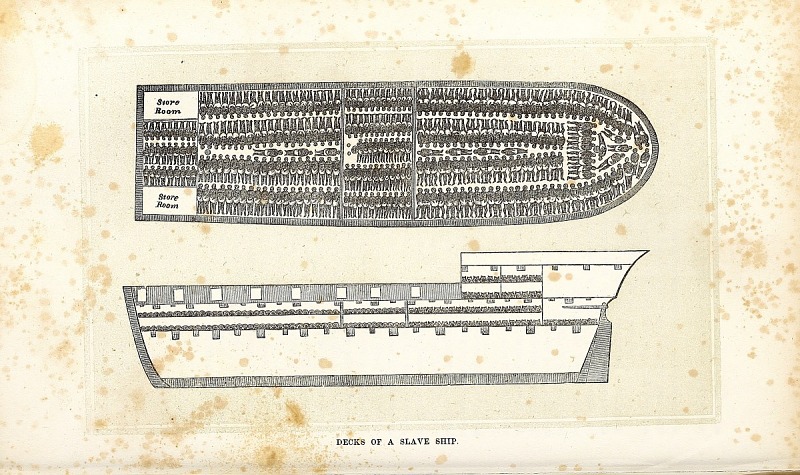
W.O., Blake. "Decks of a slaveship from The history of slavery and the slave trade, ancient and modern.", The history of slavery and the slave trade, ancient and modern, Columbus, Ohio, 1860, https://www.si.edu/object/decks-slave-ship-history-slavery-and-slave-trade-ancient-and-modern%3Asilgoi_68463. Accessed 05 May 2023.This is a picture of a cargo ship used in 1860. This ship carried slaves to and from their motherland to name the region here – North America where they would be sold. For more than four hundred years over ten million people were sold and shipped as enslaved people. These African American people were forced into slavery over these years. Forcibly removed from their motherland and sold to slaveholders. People often were kidnapped and sold in exchange for money, weaponry, land, animals, and food. On the ships, enslaved people were packed in with no bathrooms and little to no food or water by Europeans. It was a very inhumane situation to be in. Diseases often spread on these ships, which would often kill the enslaved people on board. Sharks often followed slave boats because when the enslaved people would die, the people working on board would throw the bodies overboard.
Questions
- What are cargo ships usually used for today? How does the phrase cargo ship tell you about just how many enslaved people they put on board, and how the enslaved people were treated?
- Why do you think enslavers kept packing the ships full if they were full of diseases?
- How do you think enslavers were able to continue exporting and importing enslaved people even after it was prohibited in the early 1800s?
8. Field Whip in the 1850s [Photograph]
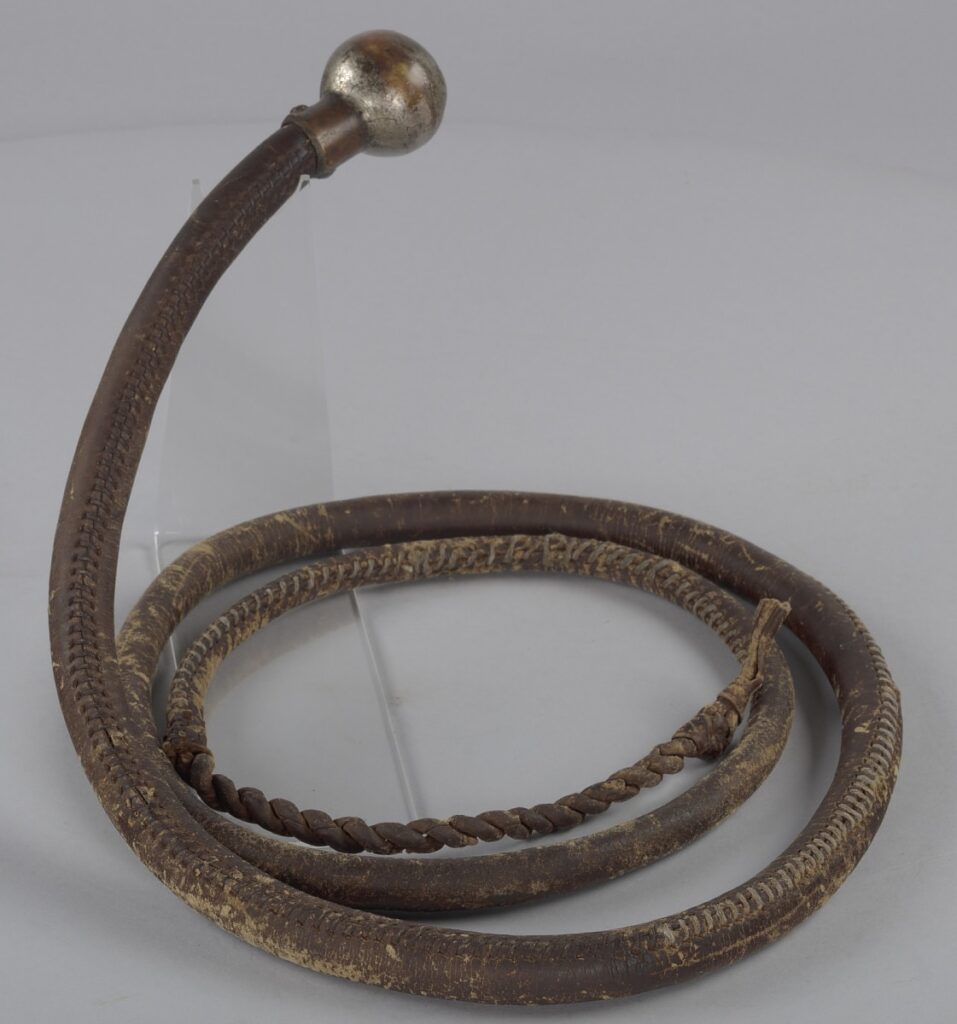
Field Whip. 1850s, Photograph, Smithsonian, Washington, D.C., National Museum of African American History and Culture: Smithsonian Institution, https://www.si.edu/object/field-whip%3Anmaahc_2014.312.112. Accessed 05 May 2023.
This is a photo of a leather whip that was used by a slaveholder on their enslaved people. It is made into a snake-coiled shape for easy recoil and carrying purposes. Slaveholders would use this on enslaved people in the field if they were not working fast enough. Whips were used by many white people during slavery. People who used whips on enslaved people would whip them for a look, word, and or motion they did not like. Slave owners would use this traumatizing and severely painful tactics in the hope that they would instill fear so that enslaved people would do whatever they were told to do. They used whips as a punishment tactic.
Questions
- How does this picture make you feel and why?
- Why do you think white people felt they were given the right to physically hurt African American people in order for them to behave?
- If enslavers needed enslaved people to be in good physical shape to do work, why would they harm them for such simple acts as looking, speaking, or moving?
9. Branding Iron used on slaves [Photograph]
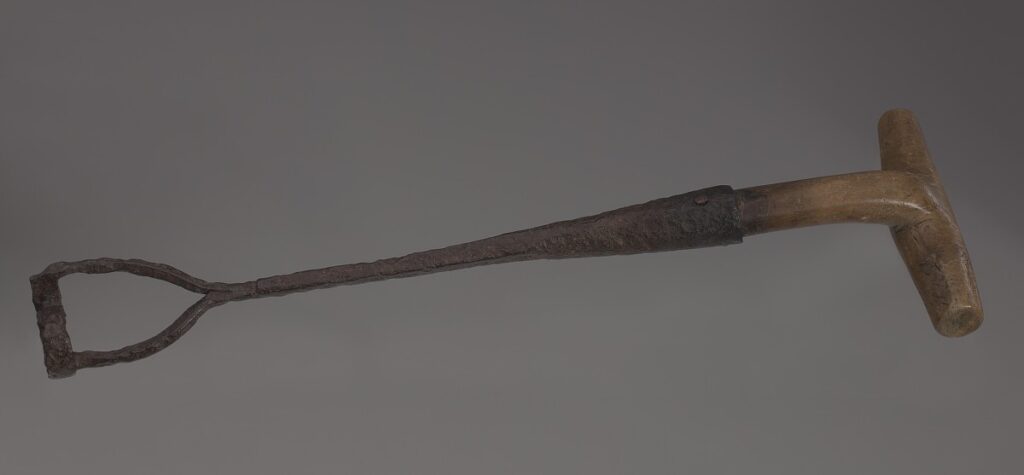
Branding iron with "S" head.1800s, Photograph, Smithsonian, Washington, D.C., National Museum of African American History and Culture: Smithsonian Institution, https://www.si.edu/object/branding-iron-s-head%3Anmaahc_2014.312.6. Accessed 05 May 2023.
Here is a branding iron that was used in the 1800s by slaveholders on the people they enslaved. Plantation owners would brand enslaved people if they were being punished or as a form of identification. The placement of the branding was most commonly found on the person’s abdomen, shoulder, and/or back. This specific branding iron has the letter “S” on the end of it standing for the word “salve”. Branding Irons are often used still today on animals for use of identification. It is a metal ion that is heated up. To brand a piece of leather the branding iron has to be between 325-400 degrees.
Questions
- What is a branding iron and how do you imagine it being used?
- How does it make you feel knowing slaveholders used branding irons on people?
- Why do you think slaveholders branded their enslaved people with the letter “S” for “slave?”
10. Frederick Douglas 1818-1895 [Photograph]
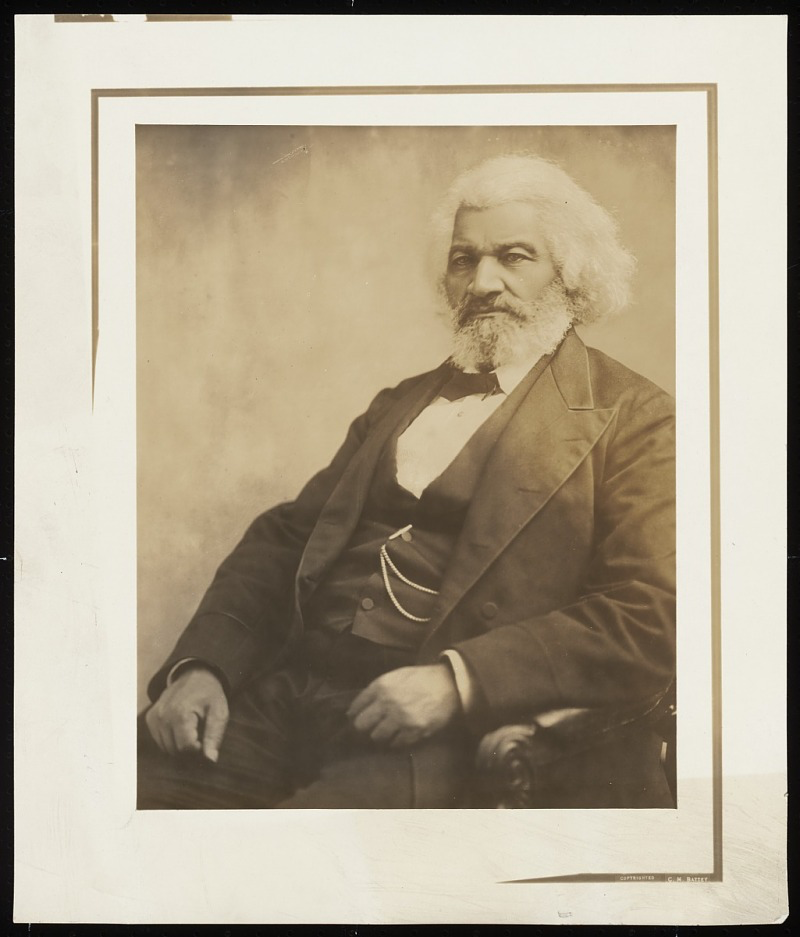
Battey, C.M., Frederick Douglass. 1895, Photograpgh, Smithsonian, Washington, D.C., National Museum of African American History and Culture: Smithsonian Institution, https://www.si.edu/object/frederick-douglass%3Anmaahc_2009.37.1. Accessed 05 May 2023.
Frederick Douglas was born enslaved in Maryland, in 1818. His mother was an African American enslaved woman, and his father was a European man. His birth name was Frederick Augustus Washington Bailey. He worked on the Wye House plantation in Maryland. Frederick was owned by an enslaver named Edward Lloyd V. Fredrick escaped to freedom, changed his name to Frederick Douglas, and became an activist. He wrote autobiographies about his life. He was a leader in the abolitionist movement. This movement helped abolish slavery during and after the Civil War. After the Emancipation Proclamation, he continued to be an activist for equality up until his death in 1895.
Questions
- Why do you think it is so common for enslaved people to change their names once they are free?
- Knowing that Frederick Douglass’ father was a white European man, why do you think he was not born a free man?
- How old was Frederick Douglas when he died and do you think this was old or young for his time and why?
11. Reward Poster for Runaway Slaves in 1840 [Poster]
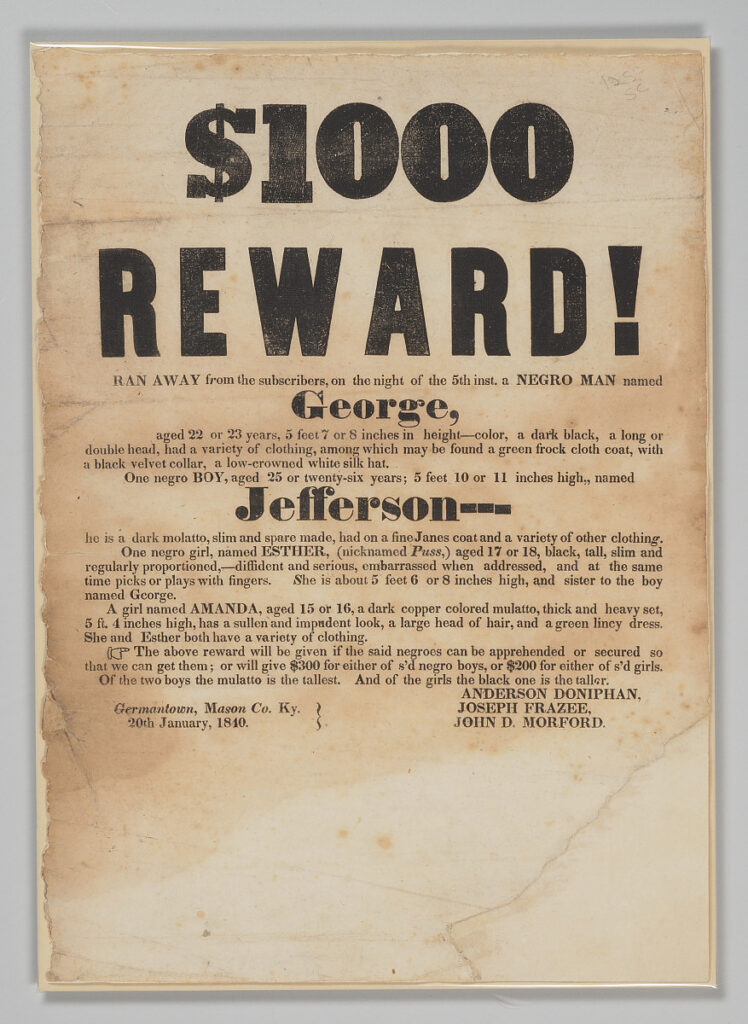
Broadside offering reward for capture of George, Jefferson, Esther, and Amanda. 20 January, 1840, Photograph, National Museum of African American History and Culture: Smithsonian Institution, https://www.si.edu/object/broadside-offering-reward-capture-george-jefferson-esther-and-amanda%3Anmaahc_2011.51.17. Accessed 05 May 2023.
Reward posts were often posted about runaway slaves. Slaves were valuable to slave owners for working purposes. They also simply did not agree with African Americans being free so they would do anything necessary to keep them from being so. The men who are slaves are stronger and seemingly more valuable to their masters so they cost more than women. People would see these posters and keep a lookout for these slaves. If found they would legally have to take them back to their owners.
Questions
- Why do you think the two men have a higher reward than the women? Explain your reasoning.
- What do you think would happen if someone found the runaway slaves and tried to keep them for themselves?
- How does it make you feel knowing that people had a price tag on their heads during slavery?
12. Slavery Days Songs and Chorus Sung by Harrigan and Har of the 1800s [Music]
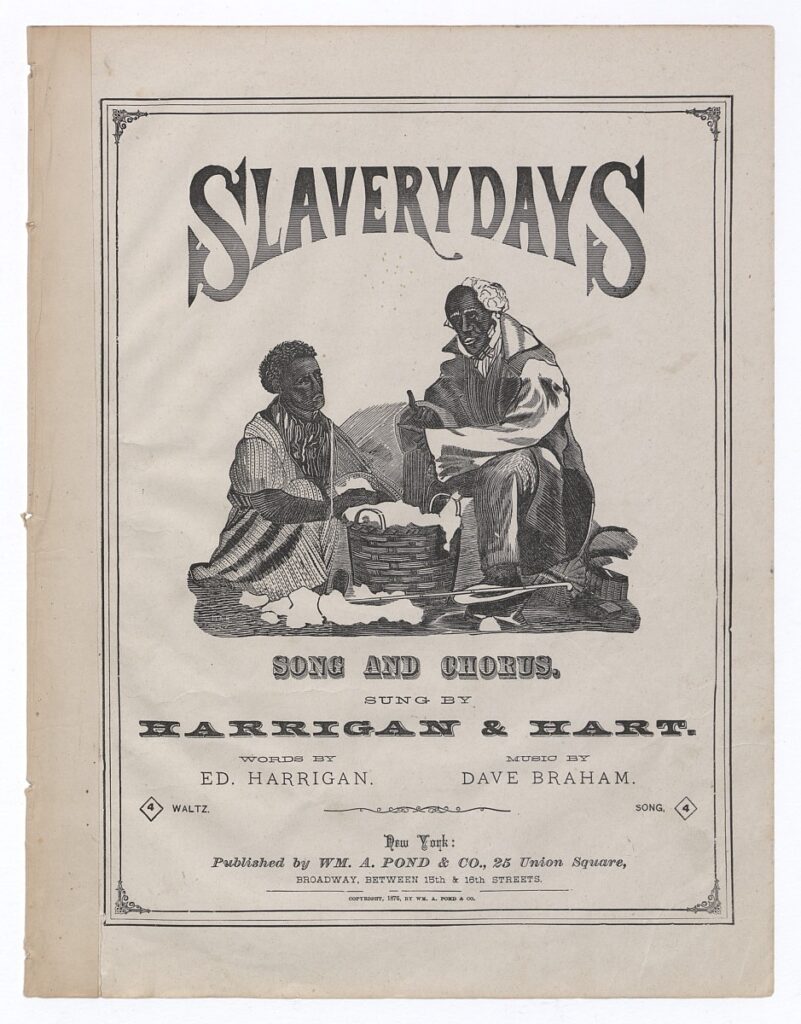
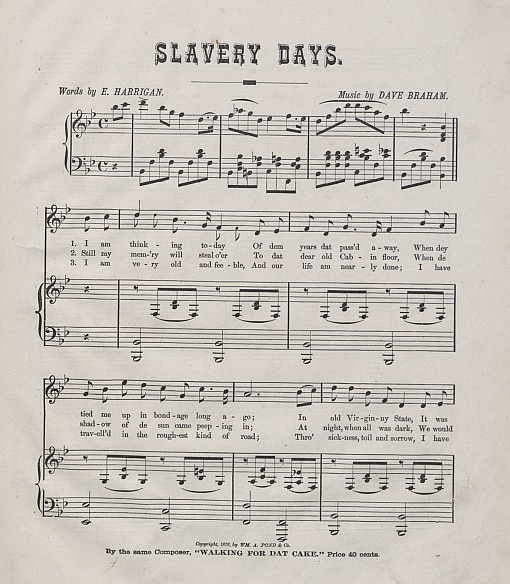
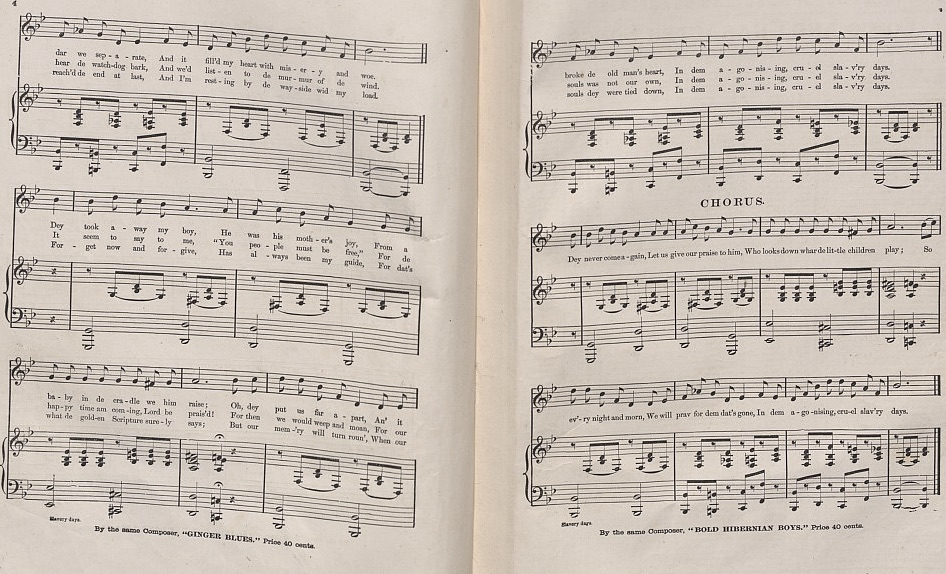
Braham, David; Harrigan, Edward. "Slavery Days Songs and Chorus Sung by Harrigan & Hart." 1876, Liljenquist Family Collection. Typescript. Smithsonian, Washington, D.C., Smithsonian Institution. https://www.si.edu/object/slavery-days-song-and-chorus-sung-harrigan-hart%3Anmaahc_2011.51.16. Accessed 05 May 2023.
Songs and hymns were very common for enslaved people to sing or hum when they were working in the fields, in the house or just walking. A lot of the songs that they would come up with or sing would be words of prayer. They would sing about their dreams and wishes. They would often pray to GOD and hope for a better future. They were often not allowed to sing out loud so they would sing it in their heads or hum it. This song in particular talks about a slave’s life and losing their son.
Questions
- Do you ever sing a song to make time pass by or be at peace?
- Who do you think sang this song since slaves often could not read or write so who made the musical notes?
- Why do you think that slaveholders did not like it when their slaves worshiped GOD or sang songs about finding freedom? Explain how this could be a threat even though white people felt and did have such a hold over African Americans’ lives.
Teacher Resources: A curated list of relevant children’s literature for teaching
- A Picture Book of Sojourner Truth, by David Adler, Gershom Griffith; https://books.google.com/books/about/A_Picture_Book_of_Sojourner_Truth.html?id=POTfv-yGjDYC
- Ben and the Emancipation Proclamation, by Pat Sherman, Floyd Cooper; https://www.google.com/books/edition/Ben_and_the_Emancipation_Proclamation/v2iPTo2t5OQC?hl=en&gbpv=0
- BOX Henry Brown Mails Himself To Freedom, by Carole Boston Weatherford, Michele Wood; https://www.google.com/books/edition/BOX_Henry_Brown_Mails_Himself_to_Freedom/BbwbEAAAQBAJ?hl=en&gbpv=0
- Calico Girl, by Jerdine Nolen; https://www.google.com/books/edition/Calico_Girl/QTMTDgAAQBAJ?hl=en&gbpv=0
- Dear America A Picture of Freedom: The Diary of Clotee, a Slave Girl, by Pat Mckissack; https://www.google.com/books/edition/A_Picture_of_Freedom/UXl0ngEACAAJ?hl=en
- Frederick Douglas A Noble Life, by Frederick Douglass, John Charles; https://www.google.com/books/edition/The_Narrative_of_the_Life_of_Frederick_D/9bdYnQAACAAJ?hl=en
- Free At Last A Juneteenth Poem, by Sojourner Kincaid Rolle; https://www.google.com/books/edition/Free_at_Last/_vWmzgEACAAJ?hl=en
- Freewater, by Amina Luqman-Dawson; https://www.google.com/books/edition/Freewater/381CEAAAQBAJ?hl=en
- Henry’s Freedom Box, by Ellen Levine; https://www.google.com/books/edition/Henry_s_Freedom_Box/8dRNCwAAQBAJ?hl=en&gbpv=0
- Love Twelve Miles Long, by Glenda Armand, Colin Bootman; https://www.google.com/books/edition/Love_Twelve_Miles_Long/qrNWjwEACAAJ?hl=en
- Mrs. Dred Scott: A Life on Slavery’s Frontier, by Lea VanderVelde; https://www.google.com/books/edition/Mrs_Dred_Scott/hOkVDAAAQBAJ?hl=en&gbpv=0
- My Name is Not Friday, Jon Walters; https://www.google.com/books/edition/My_Name_is_Not_Friday/O5WtCQAAQBAJ?hl=en&gbpv=0
- Runaway The Daring Escape of Ona Judge, by Ray Anthony Shepard, https://www.google.com/books/edition/Runaway/O-cIEAAAQBAJ?hl=en&gbpv=0
- Standing In The Need of Prayer, by Carole Boston Weatherford, Frank Morrison; https://www.google.com/books/edition/Standing_in_the_Need_of_Prayer/cDmEEAAAQBAJ?hl=en&gbpv=0
- Sweet Clara and the Freedom Quilt, by Deborah Hopkinson, James Ransome; https://www.google.com/books/edition/Sweet_Clara_and_the_Freedom_Quilt/nW3eBgAAQBAJ?hl=en&gbpv=0
- The Bell Rang, by James E. Ransome; https://www.google.com/books/edition/The_Bell_Rang/HDxqDwAAQBAJ?hl=en&gbpv=0
- The Listeners, by Gloria Whelan; https://www.google.com/books/edition/The_Listeners/XUW7BgAAQBAJ?hl=en&gbpv=0
- Who Is Harriet Tubman?, by Yona Zeldis, Nancy Harrison; https://www.google.com/books/edition/Who_Was_Harriet_Tubman/cbqnDwAAQBAJ?hl=en&gbpv=0
- William Still and His Freedom Stories The Father of the Underground Railroad, by Don Tate; https://www.google.com/books/edition/William_Still_and_His_Freedom_Stories/gW60EAAAQBAJ?hl=en
