Created by: Olivia Hukel
For Grades: 1-4 (Could Be Applicable for Higher Grades)
Table of Contents:
- Introduction
- Children’s Hospitals Education and Research Act of 1998
- News Script [Clown], Text
- Living Well: Child Life Services at Le Bonheur Children’s Hospital, Video
- Joyful and serious intentions in the work of hospital clowns: A meta-analysis based on a 7-year research project conducted in three parts, Academic Study
- Clown at Riley Hospital, Photo
- Clowns and Crowds at the annual Patients’ Carnival, Photo
- Teaching Resources
Introduction
Hello! My name is Olivia Hukel and this unconventional, liberatory journey box is about the evolution of children’s hospitals and hospital clowns. I know, you are probably thinking why is a collection about hospitals and clowns liberatory? Hopefully, after I share a little bit about my story and why I chose this topic, it will make more sense. In the summer of 2022, I got a life-threatening infection from a tick bite. When the symptoms started to become noticeable, I was on a cruise ship headed for the Bahamas (perfect timing right). I knew something was wrong, but no one could figure out why I was so sick. Eventually, the ship left me at a children’s hospital in Puerto Rico before continuing on its course. I was alone and scared; I didn’t know anyone and nothing looked familiar. Things declined before they got better, and my family prepared for the worst- don’t worry, things are about to change for the good. A doctor from back home looked at my charts and found a diagnosis. He sent word to the hospital, and I got the medicine to save my life! My time in the children’s hospital completely changed my perspective on healthcare and the experiences children have. I realized the need for play, laughter, and company in a sometimes very scary place. The inequalities, lack of funding, and lack of resources I saw inspired me to do more research. This journey box begins with a piece of legislation discussing the lack of funding being given to children’s hospitals. It then transitions into the concept of play, the history of hospital clowns, and the benefits of clown therapy. In the hospital, a doctor told me the story of Patch Adams, a surgeon who wore a bright red nose to make his patients smile (more about his work is listed under teacher resources). While this concept is rather holistic and may seem unreliable as a valid resource for healing children, it turns out clowns are believed to be present in hospitals since Hippocrates! Hospital clowns provide an escape from the intense, overwhelming reality many hospitalized children are experiencing. I hope my story and these resources inspire educators and anyone reading to expose young learners to the joys, fears, and miracles of children’s hospitals.
1. Children’s Hospitals Education and Research Act of 1998
[Citation of Source, uses "Preformatted" content block] (1998). Bill. H.R. 3855, 105th Congress.
Above is a pdf document of the Children’s Hospitals Education and Research Act of 1998. The purpose of the act was to create a bill to provide for payments to children’s hospitals that operate graduate medical education programs. The concerns I want to highlight are as followed: “Freestanding children’s teaching hospitals receive almost no Federal graduate medical education funding. With few Medicare patients, these children’s teaching hospitals receive less than $400 in Federal funds for each medical resident they train, while other teaching hospitals receive on average more than $79,000 for each resident they train, creating a very serious inequity in the competitive market for these children’s hospitals, (page 2).” A solution educators should address is, “The Secretary shall make payment under this section to each children’s hospital for each hospital cost reporting period beginning during the fiscal year 1999 or fiscal year 2000 for the direct and indirect expenses associated with operating approved medical residency training programs, (page 3).”
Questions
- Why do you think children’s hospitals need so much funding? Do you think children’s hospitals should receive more or less funding than general hospitals? Why?
- Should pediatricians be trained more or less than general doctors? Why or why not?
- What is the purpose of having hospitals for children and hospitals for adults? Why not have everyone go to the same hospital?
2. News Script [Clown], Text

WBAP-TV (Television station : Fort Worth, Tex.). [News Script: Clown], item, December 30, 1965; (https://texashistory.unt.edu/ark:/67531/metadc981955/: accessed May 20, 2023), University of North Texas Libraries, The Portal to Texas History, https://texashistory.unt.edu; crediting UNT Libraries Special Collections.
This script excerpt is about Emmett Kelly-junior, the sad-faced clown, visiting a children’s hospital in Dallas. I do not like the use of the word “crippled” in this context. If you are showing this document to students, consider discussing why this word can be harmful and/or not using the word at all (you can still understand the context without using the hospital name). This script is from the WBAP-TV/NBC station in Fort Worth, Texas, covering a broadcast news story. It was produced on December 30, 1965.
Questions
- Why do you think Emmett has a sad face? Do you think he still made the children happy?
- How do you think the children understood him if he didn’t speak?
- What would you want your clown name to be if you were a hospital clown? How would you dress and do your makeup?
3. Living Well: Child Life Services at Le Bonheur Children’s Hospital, Video
GHS-TV. (2014). Living Well: Child Life Services at Le Bonheur Children’s Hospital. Internet Archive. Retrieved May 20, 2023, from https://archive.org/details/ghstn-Living_Well_-_Child_Life_Services_at_Le_Bonheur_Children_s_Hospital.
Reporter Hayley Bardos and editor Collin Nelson look at the child life services offered by Le Bonheur Children’s Hospital. This report aired on Living Well on 3/9/14. This video is part of a larger Living Well series. Their goal is to ensure every child feels comfortable and safe during their hospital visits. The primary focus is on the importance of play and dramatizing events by connecting the serious and scary parts of being in a hospital to playing. Children can use play and acting as a way to understand heavy, intense topics like death.
Questions
- How do the children look in the video? Do they look scared or nervous?
- Why do you think playing and laughter are so important in the hospital?
- What experiences have you had in the hospital? Did the nurses, doctors, or other hospital workers make you feel safe and comfortable?
4. Joyful and serious intentions in the work of hospital clowns: A meta-analysis based on a 7-year research project conducted in three parts, study
Linge, L. (2013). Joyful and serious intentions in the work of hospital clowns: A meta-analysis based on a 7-year research project conducted in three parts. International Journal of Qualitative Studies on Health and Well-Being, Volume 8. https://doi.org/ 2013-01-04
This study is a seven-year research project funded by the Swedish Childhood Cancer Foundation. Its goal was to see the benefits of hospital clowns on patients. The meta-analysis revealed the unique aspects of hospital clowns’ work with respect to a) a quality of care that transcends boundaries, that is, a magical safe area where demands and adjustment were temporarily set aside and where the lighter side of life took precedence; b) a non-demanding quality of care, where joy could be experienced without requiring something in return, where the child’s terms mattered and where the child perspective was clearly in focus; and c) a defusing quality of care, which is expressed as a positive counterweight that was otherwise lacking in medical care, where the hospital clowns used different solutions that bypassed regular hospital routines by temporarily distracting and making things easier for the children, parents, and staff in various care situations.
Questions
- How much say should a child have in their healthcare- when they receive treatment, what they get to play with, who they want in the room, etc?
- Should the parents or guardians be the sole voice for their children? Why or why not?
- If you were a hospital clown, what would you do to cheer up a child?
5. Clown at Riley Hospital, Photo
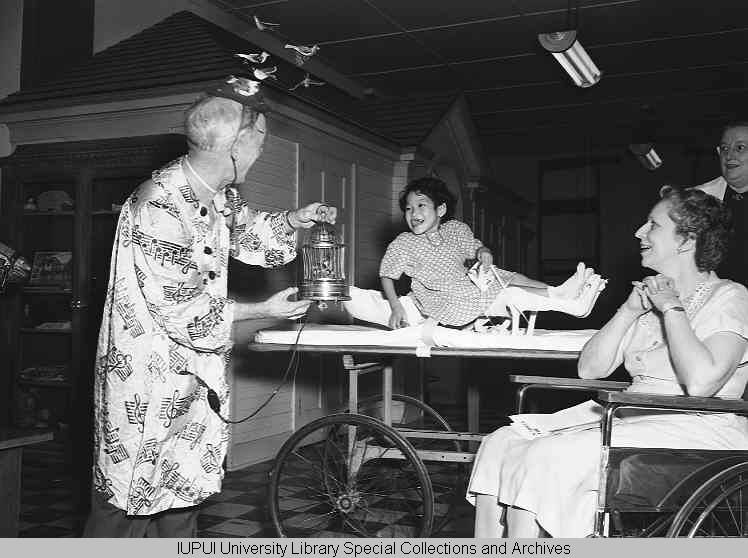
IUPUI (Campus). University Library. (n.d.). Clown at Riley Hospital. Indiana Memory Hosted Digital Collections . photograph. Retrieved May 18, 2023, from https://indianamemory.contentdm.oclc.org/digital/collection/IUPUIphotos/id/4338.
The clown (shown to the left) was visiting the young girl (seen on the bed) during her occupational therapy time. This photo was taken at Riley Hospital. While the photographer and time period is unknown, this photo is part of a large collection from Indiana University.
Questions
- Look at the clown, what is he holding? What do you think he is doing?
- Look at the patient’s face, what do you notice?
- When do you think this photo was taken? Pay attention to the bed the child is laying on.
6. Clowns and Crowds at the annual Patients’ Carnival, photo
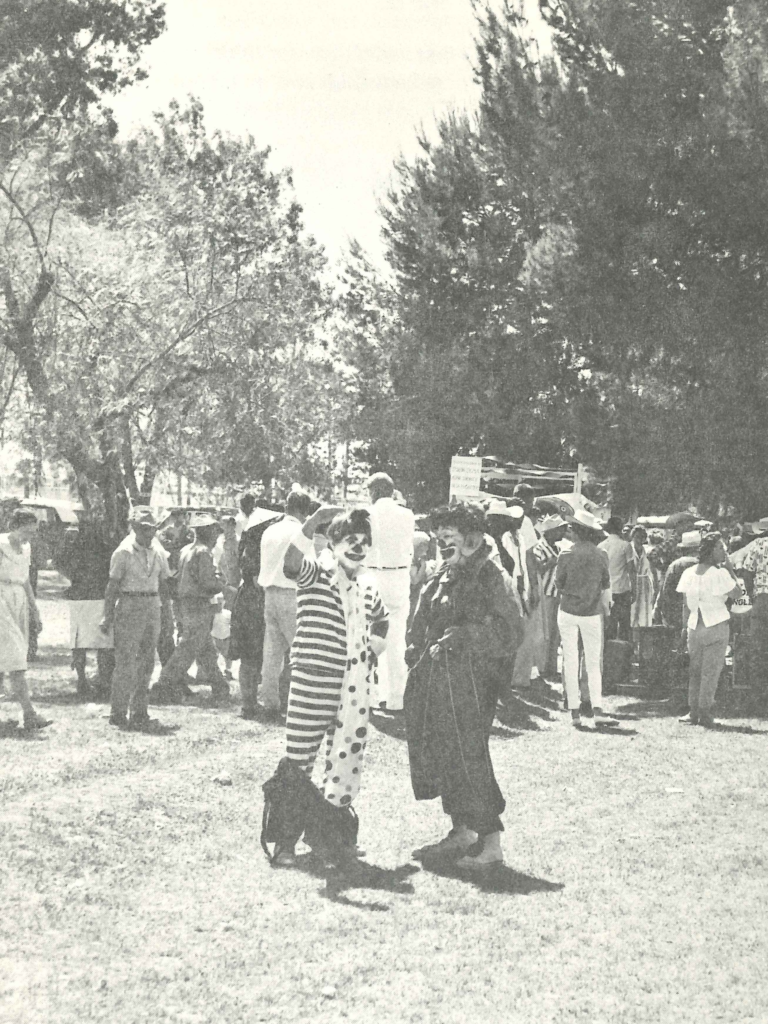
(2020). (rep.). Annual report of the Arizona State Hospital 1963. Retrieved May 15, 2023, from https://archive.org/details/ashannual1963/page/46/mode/2up.
This photo is part of an annual report from Arizona State Hospital in 1963. The full report will also be linked for teachers to explore, but I wanted to showcase the photo of the clowns for this project. An excerpt of the text that accompanies the photo is as followed: “A major trend this year has been to include more patients in off-ground activities to familiarize them with community recreational facilities as part of the total rehabilitation program. This department has always worked on holidays to aid in establishing a balanced pattern of work and recreation in hospital life. Evening hours also are a common part of a day’s relaxation and recreation in community life,” (page 46, page 50 of the pdf).
Questions
- Why do you think they decided to add this photo to their catalog?
- What else is happening in the photo? Look closely at the people in the background, what is going on?
- What do you think the clowns are talking about?
Teaching Resources
- Gesundheit!, by Patch Adams, https://www.patchadams.org/store/gesundheit-book/
- The Hospital: The Inside Story, by Dr. Christle Nwora and Ginnie Hsu, https://neonsquidbooks.com/books/the-hospital/
- The Unstoppable Maggie McGee, by Juliet Clare Bell, https://www.littleparachutes.com/books/the-unstoppable-maggie-mcgee/
- https://aath.memberclicks.net/assets/docs/humor-articles/caring_clown_research.pdf
