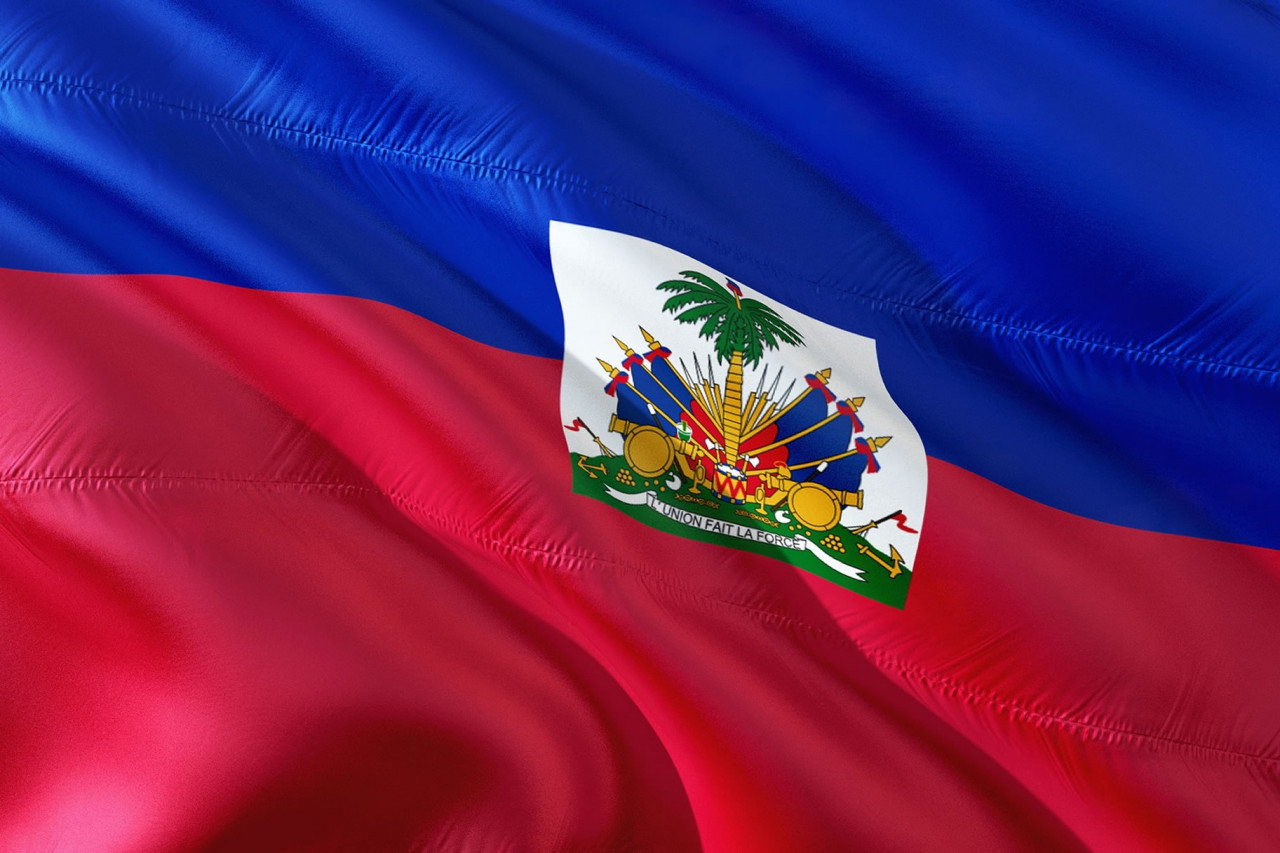
Haitian Revolution
Created By: Addison Anderson
Grades: 4th+
Table of Contents
- Introduction
- Le Code Noir (The Black Code), text
- Resolution of the Savannah City Council, text
- Toussaint L’Ouverture Ruling, text
- Toussaint L’Ouverture on Horseback, portrait
- Introduction of the Haitian Declaration of Independence, text
- Dessalines: First Emperor of Haiti, portrait
- Teaching Resources
- Explore More
Introduction
In 1492, Christopher Columbus landed on the land of the Taíno and Arawakan people, who called the region “Ayiti”. This whole island of Hispaniola, now recognized as Haiti and the Dominican Republic, was then colonized by Spain for many years. In 1625, France took over the territory of Haiti, and renamed it Saint-Domingue. The colony became highly profitable, as the Caribbean environment supported coffee and sugar production. France enslaved the natives of Haiti, the Taíno and Arawakans, and forced them to work– all in order to help France’s economy. Despite Saint-Domingue’s relatively small size, around one third of the Atlantic Slave Trade took place on the island. France’s own revolution in 1789 affected laws in the colony of Saint-Domingue, and some French revolutionaries attempted to incite riots on the island as well.
The first official revolt of enslaved people occurred in 1791 and marked the beginning of the Haitian Revolution. This revolt occurred in the northern parts of the island, but word quickly spread and soon thousands of enslaved people and rebels began to revolt by burning plantations and assisting others in escaping their enslavers. At this time, Toussaint L’Ouverture emerged as a leader. He was born into enslavement himself, but was a freeman at the start of the revolution, where he was working his way up socially. Despite his status, L’Ouverture led troops of enslaved people in the fight for freedom. His political and military prowess encouraged the nation, and helped lead to the abolition of slavery in France and its colonies.
By 1801, Toussaint L’Ouverture was the leader of the entire island of Hispaniola, and slavery had been renounced. He maintained relationships with France in order to keep positive diplomacy and for more assurance that the abolition of slavery would remain. This alliance with France proved to be unhelpful, as Napoleon Bonaparte, the First Consul of France, sent troops to Saint-Domingue in order to restore French rule and remove L’Ouverture as Governor General. The war between Saint Domingue and France continued, but Toussaint L’Ouverture, along with many others defending the island, were arrested and taken to France by Bonaparte’s troops. There were many battles fought between the troops, with France initially seeming victorious, but the troops of Saint Domingue used plans left by L’Ouverture and other leaders, which helped them to emerge victorious. On January 1, 1804, Jean-Jacques Dessalines, a prominent general in the war, declared independence for the nation, and renamed the island “Haiti” based on the previous name of “Ayiti” from the Taíno people.
This Journey Box represents the journey to Haiti’s freedom, which is a rich history not often discussed in classrooms. As a Haitian-American myself, I think it is time that the strength of Haiti as the first free Black republic is highlighted and celebrated. I personally transcribed and translated certain documents that are included in this Journey Box, which made me even more personally attached to this process. Haitian’s Revolution is a story of Black resistance and taking back power from enslavers and colonizers. Due to heavy subjects, this journey box is appropriate for 4th grade students and above.
1. Le Code Noir (The Black Code), text
Excerpts:
“Article II. All slaves that shall be in our islands shall be baptized and instructed in the Roman, Catholic, and Apostolic Faith. We enjoin the inhabitants who shall purchase newly-arrived Negroes to inform the Governor and Intendant of said islands of this fact within no more than eight days, or risk being fined an arbitrary amount. They shall give the necessary orders to have them instructed and baptized within a suitable amount of time…
Article XLIV. We declare slaves to be charges, and as such enter into community property. They are not to be mortgaged, and shall be shared equally between the co-inheritors without benefit to the wife or one particular inheritor, nor subject to the right of primogeniture, the usual customs duties, feudal or lineage charges, or feudal or seigneurial taxes. They shall not be affected by the details of decrees, nor from the imposition of the four-fifths, in case of disposal by death or bequeathing…
Article XXXIII. The slave who has struck his master in the face or has drawn blood, or has similarly struck the wife of his master, his mistress, or their children, shall be punished by death”
"THE CODE NOIR (THE BLACK CODE)," in World History Commons, https://worldhistorycommons.org/code-noir-black-code
The Black Code was an edict – an order – given by Louis XIV, the King of France, in 1685. This code was slightly modified over time, but the edict established the laws surrounding slavery and enslaved people for the next century. The code arrived in Saint Domingue in 1687. Enslavers adopted the articles which included rules such as defining enslaved people as property, disobedience being punishable by death, and instructions that all enslaved people be baptized the same religion as the King: Catholic.
Questions
- Why did Louis XIV enforce a common religion? What significance does that have?
- What does property mean? What does it mean for a person to be property?
- Who do you think was enforcing these rules?
2. Resolution of the Savannah City Council, text
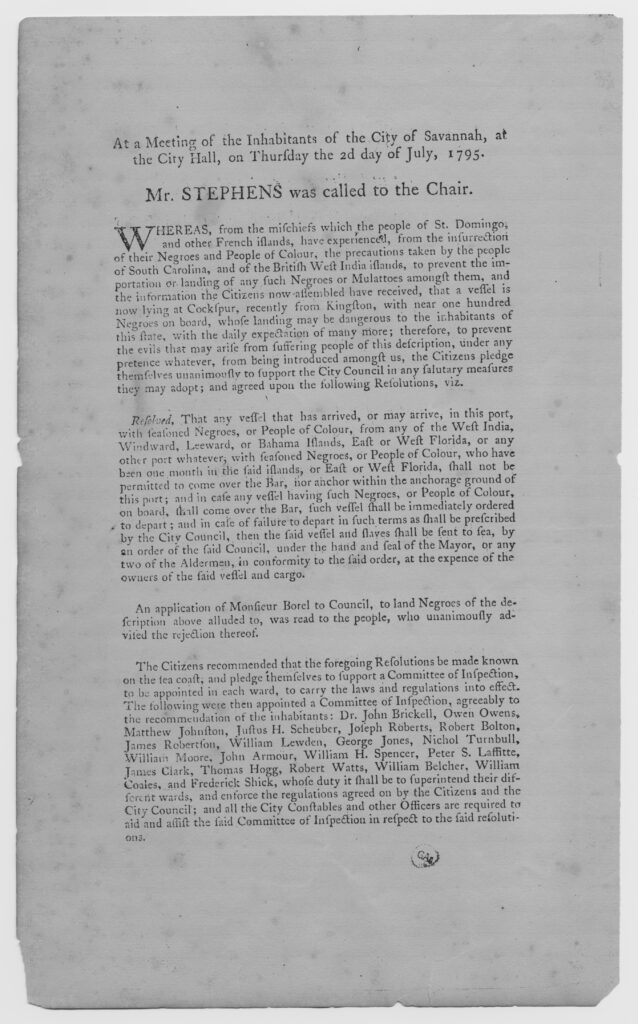
“Whereas, from the mischiefs which the people of St. Domingo, and other French islands, have experienced, from the insurrection of their Negroes and people of color, the precautions of the people of South Carolina, and of the British West India islands, to prevent the importation or landing of any such Negroes or Mulattoes amongst them, and the information the Citizens now assembled have received, that a vessel is now lying at Cockspur, recently from Kingston, with near one hundred Negroes on board, whose landing may be dangerous to the inhabitants of this state, with the daily expectation of many more, therefore, to prevent the evils that may arise from suffering people of this description, under any pretense whatever, from being introduced amongst us, the Citizens pledge themselves unanimously to support the City Council in any salutary measures they may adopt, and agreed upon the following resolution.
Resolved. That any vessel that has arrived, or may arrive, in this port, with seasoned Negroes, or People of Color…. such vessel shall be immediately ordered to depart; and in case of failure to depart in such terms as shall be prescribed by the City Council, then the said vessel and slaves shall be sent to sea…”
Schomburg Center for Research in Black Culture, Manuscripts, Archives and Rare Books Division, The New York Public Library. "Resolution of the Savannah City Council to prevent Blacks from entering the city following the Haitian Revolution." The New York Public Library Digital Collections. 1795. https://digitalcollections.nypl.org/items/a5835e40-c6cf-012f-4950-58d385a7bc34
At a City Hall meeting in Savannah, Georgia, William Stephens presided over the citizens to announce the resolution to prevent Black people from entering the city. This resolution took place shortly after the abolition of slavery in Saint-Domingue, when formerly enslaved people were leaving the island by boat and trying to enter other ports. This decision was unanimous – fully agreed upon- by the citizens of Savannah to prevent Haitians and other people of color from entering.
Questions
- Why do you think formerly enslaved people on Saint Domingue were traveling to other ports? Why Savannah specifically?
- Why do you think Savannah residents unanimously agreed to prevent the arrival of ships holding people of color?
- What do you think were the reactions to this resolution?
3. Toussaint L’Ouverture Ruling, text
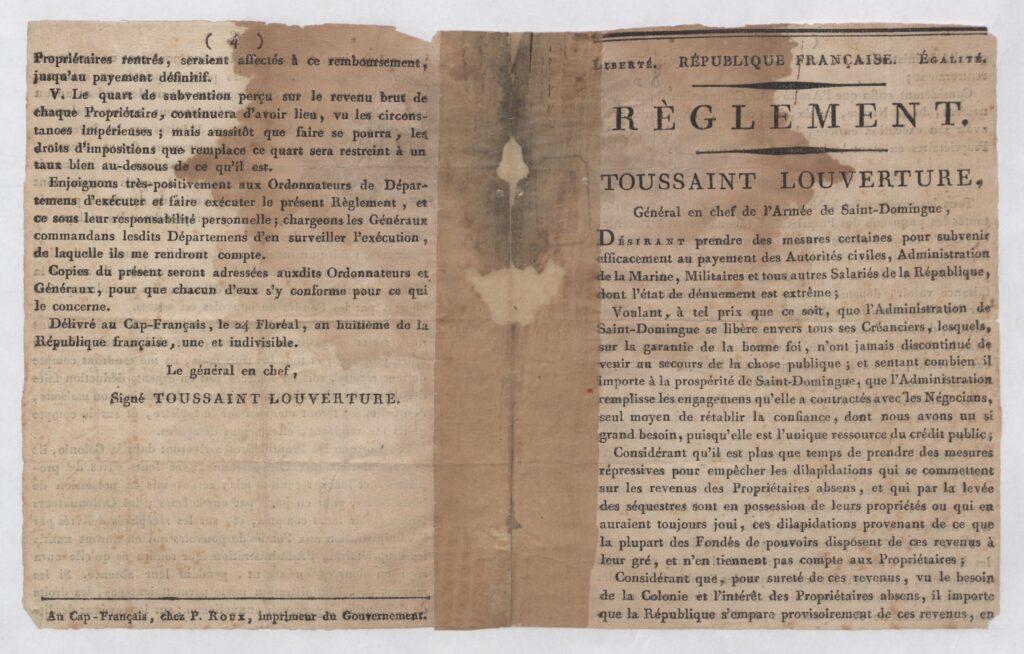

Excerpts translated by Addison Anderson:
“Ruling. Toussaint L’Ouverture, General in chief of the Army of Saint Domingue.
Desiring to take certain measures to effectively provide payment for… all Employees of the Republic whose state of destitution is extreme,
Wanting, at any price whatsoever, that the Administration of Saint Domingue free itself from all its Creditors…
Considering finally that the Decree of the Commission of the Government of 23 Nivose [December/January], year six, in this respect, should have always had in its execution, the interests of the Colony… decrees the following:
I. All incomes from dwellings, houses in the City, still in the property of absent owners shall in the future… be paid into the stores and into the coffers of the Republic…
II. All the attorneys of the said absentee proprietors, if they reside on the dwellings are there to improve them, shall receive five percent of the gross income of said dwellings… all the power of attorney who do not reside in the dwellings, will not be able to receive the five percent mentioned, because it is unfair that the power of attorney eats up the income of the owners with impunity…
V. The quarter subsidy imposed on the gross income of each owner will continue to take place, given the compelling circumstances; but as soon as possible, the taxing which this quarter replaces will be restricted to a rate far below what it is. We very positively enjoin the directors of departments to execute and enforce the present regulations…”
Schomburg Center for Research in Black Culture, Manuscripts, Archives and Rare Books Division, The New York Public Library. "Toussaint Louverture, General-in-Chief of St. Domingue's Army; Cap-Français, St. Domingue" The New York Public Library Digital Collections. 1799. https://digitalcollections.nypl.org/items/460eda20-d97d-0137-50b9-273bbf2b6cdb
There were many citizens of France, who still owned land on Saint Domingue following the abolition of slavery on the island. The ruling established laws for what happens to the properties of these owners, if they don’t take care of their property. Toussaint L’Ouverture announced this ruling while he was serving as General-in-Chief of Saint Domingue’s Army. His emphasis on improving the dwellings was primarily to bring in more money for Saint Domingue. This occurred through taxation, as well as the income from these dwellings going to businesses in Saint Domingue. This ruling also caused many French citizens to sell their land back, which gave land and money back to the citizens of Saint Domingue.
Questions
- Why do you think that Toussaint L’Ouverture’s focus was on the economy of Saint Domingue?
- What do you think was the response of the people of Saint Domingue to this ruling?
- What do you think was the response of the French people to this ruling?
4. Toussaint L’Ouverture on Horseback, portrait
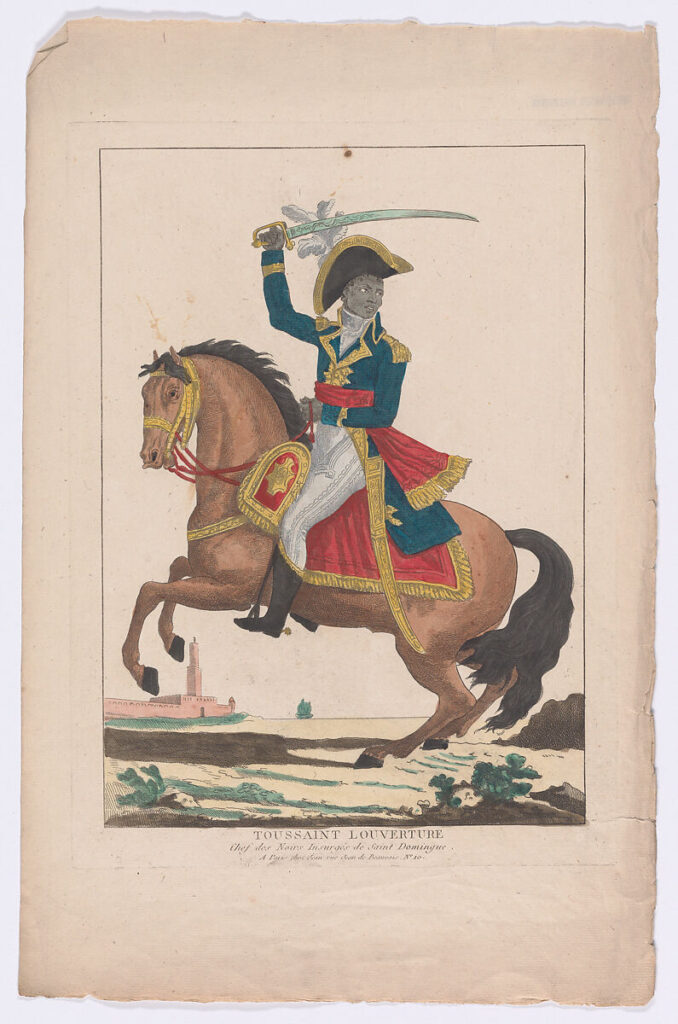
Anonymous. Toussaint Louverture on Horseback. 1802. The Metropolitan Museum of Art, https://www.metmuseum.org/art/collection/search/852915
Toussaint L’Ouverture helped abolish slavery in Saint-Domingue by leading enslaved people in uprisings to fight for their freedom. He had been born into slavery himself in 1743. After they succeeded in abolishing slavery in 1793, he continued passionately leading by becoming the first Black general of the French Republic, and then Saint-Domingue’s commander in chief. Because L’Ouverture was such an influential leader, Napoleon Bonaparte’s troops kidnapped him and took him as prisoner without a trial. He died in their prison from illness in 1803. Artists created many portraits of him during his life and following his death, due to his acclaimed status.
Questions
- What do you notice about this portrait? What details do you see?
- What does this portrait make you think about Toussaint L’Ouverture? What message is it trying to convey?
- Why do you think Napoleon’s troops kidnapped and imprisoned Toussaint L’Ouverture?
5. Introduction of the Haitian Declaration of Independence, text
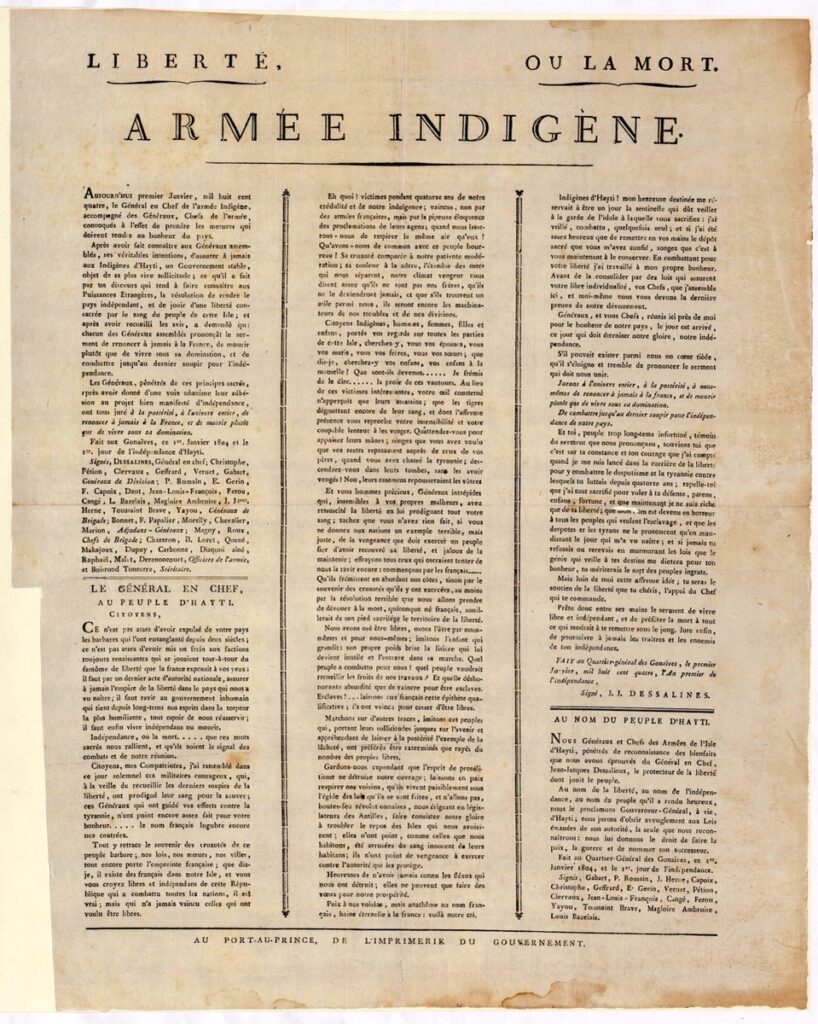
Excerpt translated by Addison Anderson:
“Today, January 1, 1804, the General in Chief of the Indigenous Army, accompanied by Generals and Army Chiefs convened in order to take measures tending to the happiness of the country:
After having made known to the assembled Generals, his true intentions, to forever ensure to the natives of Haiti, a stable government – the object of his deepest solicitude, which he did in a speech that made known to Foreign Powers the resolution to make the country independent, and to enjoy the liberty consecrated by the blood of the people of this island; and, after having collected their opinions, asked each one of the assembled generals to pronounce a vow to forever renounce France; to die rather than to live under its domination; and to fight for independence until their last breath.”
Jean-Jacques Dessalines, “Haitian Declaration of Independence,” USU Digital Exhibits, http://exhibits.usu.edu/items/show/17664.
General-in-Chief Jean-Jacques Dessalines declared Haiti independent from France on January 1st, 1804. He also changed the name of Saint Domingue back to Haiti, based on the name the Taíno natives named it (“Ayiti”) meaning “land of high mountains”. Any previous proclamation by a Haitian official had the French motto “Liberty, Equality, Fraternity” on it, but this declaration had “Liberty or Death” on the top of the page. This Declaration symbolizes years of fighting for freedom, and an ultimate success that is still celebrated by Haitians on every New Year’s Day.
Questions
- Why do you think they changed the header from “Liberty, Equality, Fraternity” to “Liberty or Death”?
- What is the significance of the name of the island changing back to Haiti from Saint-Domingue?
- How do you think it felt to finally declare independence from France after years of resistance?
- What do you notice about the word choice in the Declaration of Independence itself?
6. Dessalines: First Emperor of Haiti, portrait
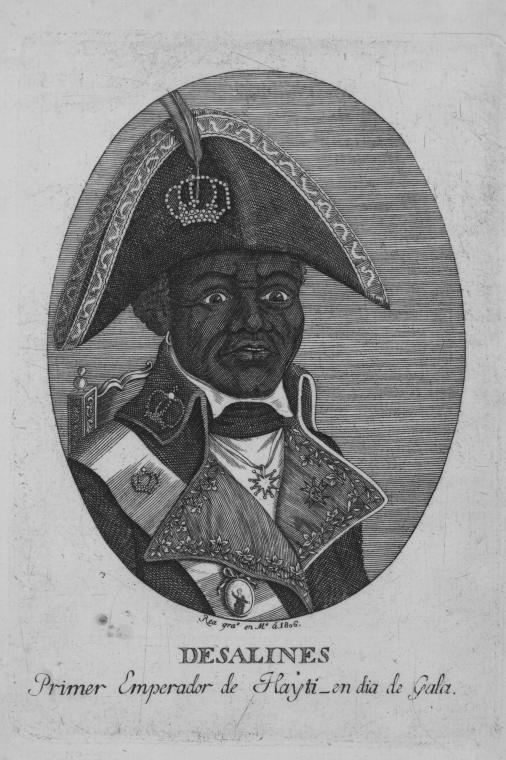
Schomburg Center for Research in Black Culture, Manuscripts, Archives and Rare Books Division, The New York Public Library. "Desalines primer Emperador de Hayti en dia de Gala" The New York Public Library Digital Collections. 1806. https://digitalcollections.nypl.org/items/19268590-c623-012f-9eff-58d385a7bc34
Jean-Jacques Dessalines was the First Emperor of Haiti following the revolution. Previous to that, he served as a general in the battles against France and as a lieutenant under Toussaint L’Ouverture. He was born into slavery in 1758, but he was later freed by a free Black man whose last name he took, which made him the Dessalines known today. He bravely fought in battles from the start of the revolution to the end, leading to Napoleon Bonaparte surrendering in December of 1803. Dessalines declared Haiti’s independence on January 1st, 1804. It is said that his wife, Marie-Claire, passed out soup joumou [joo-moo] (pumpkin soup) to everyone gathered on that day, and now the soup is eaten every year on New Year’s to celebrate Haiti’s independence. There were still tensions following the end of the revolution and disagreements within Haiti’s new administration, which led to Dessalines’ assassination in 1806.
Questions
- What do you notice about this portrait? What is Dessalines’ outfit portraying?
- What similarities do you notice between Dessalines’ life and L’Ouverture’s life?
- What is the significance of the soup joumou?
Teaching Resources
- Auntie Luce’s Talking Paintings, written by Francie Latour and illustrated by Ken Daley, https://houseofanansi.com/products/auntie-luces-talking-paintings
- Freedom Soup, written by Tami Charles and Illustrated by Jacqueline Alcántara, https://www.penguinrandomhouse.com/books/611939/freedom-soup-by-tami-charles-illustrated-by-jacqueline-alcantara/
- Haiti: The First Black Republic, written by Frantz Derenoncourt, Jr. and illustrated by Eminence System, https://www.goodreads.com/en/book/show/28590544
- Toussaint L’Ouverture: The Fight for Haiti’s Freedom, written by Walter Dean Myers and illustrated by Jacob Lawrence, https://www.goodreads.com/en/book/show/564789
Explore More
There are so many more aspects to Haitian culture that would be exciting to explore while discussing the Haitian Revolution. The events of the revolution can sometimes be heavy to take in, so here are some other resources to help bring light and positivity back into the classroom while handling this work.
Kompa Playlist
Soup Joumou Recipe
Though the best recipes are passed down through family, there are some wonderful recipes online for Soup Joumou, also called Freedom Soup. It’s a thick soup with pumpkin and/or squash, potato, pasta, peppers, and a protein (most commonly beef). It’s tradition to eat the soup on New Year’s Day to celebrate Haitian Independence Day. Here a few links to some delicious recipes:
- https://cooking.nytimes.com/recipes/1021716-soup-joumou
- https://haitian-recipes.com/soup-joumou/
- https://www.caribbeangreenliving.com/how-to-make-haitian-soup-joumou/
- Recipe at the back of the suggested text, Freedom Soup
