Created by: Gabrielle Walters
For Grades: 4-6
Table of Contents
- Introduction
- Letter From Alabama Male Opposed to The 19th Amendment, document
- Names of Attendees at The Woman’s Rights Convention in Seneca Falls, document
- Frederick Douglass, portrait
- Memorial of American Equal Rights Association to the Congress of The United States, document
- Elizabeth Cady Stanton and Susan B. Anthony, picture
- Alice Paul, newspaper
- Woman’s Suffrage Parade, March 1913, picture
Introduction
This journey box introduces you to the experiences and history of the Women’s Suffrage Movement using photographs, newspaper clippings, and written pieces. The Women’s Suffrage Movement was the women’s fight for the right to vote. This journey box includes pieces from the Seneca Falls Convention, pieces of literature written by men against the movement, images of notable figures, and the March 3rd Convention. In 1848, women gathered at the Wesleyan Methodist Church in Seneca Falls, New York to discuss issues involving gender equality and women’s rights. This was the first Women’s Rights Convention in the United States and the start of a twenty-year battle to gain the right to vote. Many of the white women leading the movement expressed racism and classism within the movement. This included the discrimination of black men and women and uneducated women. I have included pieces that disrupt the traditional ideas about notable figures in this movement and what they actually stood for, in particular Frederick Douglass, Elizabeth Cady Stanton, and Susan B. Anthony. This journey box represents the hardship women went through during this time and emphasizes the discrimination black men and women endured from this movement. Both children and adults have to dig in and think about why events occurred. This topic is particularly important to me because I am a woman. Especially, in this day and age, when we have seen certain women’s rights, that our ancestors fought so hard for, be reversed. I have always been interested in understanding the complex history of the Suffrage Movement. This journey box has allowed me to learn a lot more about the topic than I ever knew, and I hope it does the same for you.
1. Letter From Alabama Male Opposed to The 19th Amendment

Letter from the Alabama Male Association Opposed to Woman's Suffrage; 9/23/1918; Petitions and Memorials, Resolutions of State Legislatures, and Related Documents which were Presented, Read, or Tabled during the 65th Congress; (SEN64A-K11); Petitions and Related Documents That Were Presented, Read, or Tabled, 1789 - 1966; Records of the U.S. Senate, Record Group 46; National Archives Building, Washington, DC. [Online Version, https://www.docsteach.org/documents/document/alabama-opposition-suffrage, May 21, 2023]
During the start of the Women’s Suffrage Movement, many men were opposed to the idea of allowing women the right to vote. In this letter, a man by the name of, Martin L. Calhoun, writes to the senator of Alabama in 1918 opposing the proposed Susan B. Anthony law (later known as the 19th amendment). He wrote that each state should “be permitted to solve the issue for itself,” and asks “in all seriousness – what will become of white supremacy in the grand old South?”
Questions
- Read over the letter, what do you think the man is trying to say he is against?
- What seems to be the importance of keeping the right to vote prohibited from women and black men?
- Why do you think so many people, even some women, were opposed to women receiving the right to vote?
2. Names of Attendees at The Woman’s Rights Convention in Seneca Falls

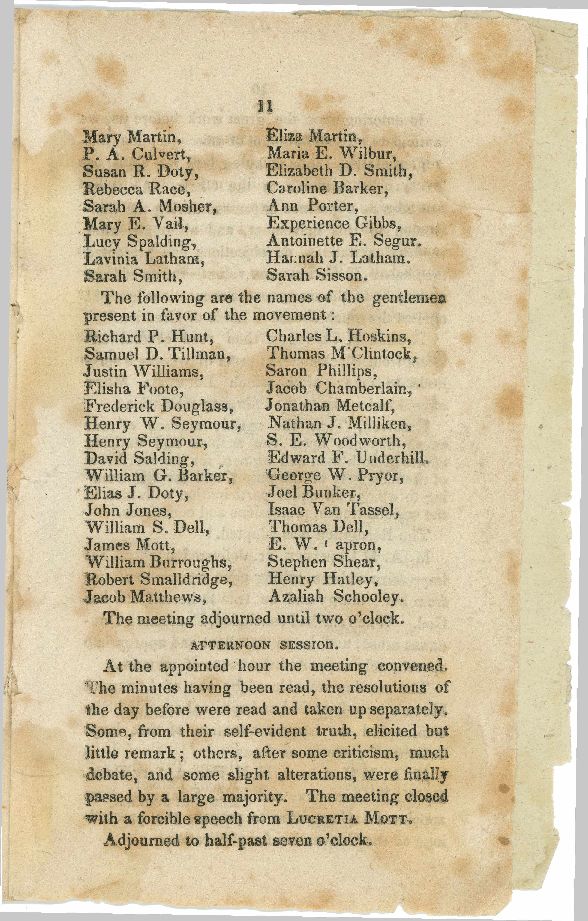
(1848) Report of the Woman's Rights Convention, held at Seneca Falls, New York, July 19th and 20th, . Proceedings and Declaration of Sentiments. John Dick at the North Star Office, Rochester, New York, July 19-20. [Online Text] Retrieved from the Library of Congress, https://www.loc.gov/item/rbcmiller001106/.
The Seneca Falls Convention was the first Woman’s Rights Event held. The convention was called to discuss the civil and political rights of women. Their main focus was being treated as equals to men, having more opportunities, and to vote. On the second day of the convention, attendees signed the Declaration of Sentiments and Grievances. What you see above is the signatures of men and women in attendance who supported the document.
Questions
- What do you notice about the names signed in support of the civil and political rights of women?
- We hear a lot about the women who contributed to the movement, but not the men, why do you think that is?
- How do you think the men felt to be the minority in the convention? How do you think the women felt to see men in support of their movement?
3. Frederick Douglass

Source: Art Institute of Chicago
Frederick Douglass’ devotion to the Woman’s Rights Movement, reflected on his belief that rights should be universal. He believed that oppressed groups should support one another. He played a critical role in the Seneca Falls Woman’s Rights Convention. Douglass helped secure approval for a suffrage revolution.
Questions
- What do you know about Frederick Douglass? Do you know his name or anything at all about him?
- Considering the years his portrait was made, and his belief that rights should be universal. What other movements do you think Frederick Douglass stood with?
- Why do you think Frederick Douglass, who is a man, wanted to support the woman’s movement?
4. Memorial of American Equal Rights Association to the Congress of the United States

Memorial of American Equal Rights Association to the Congress of the United States; 1/3/1867; (HR 39A-H14.2); Petitions and Memorials, 1813 - 1968; Records of the U.S. House of Representatives, Record Group 233; National Archives Building, Washington, DC. [Online Version, https://www.docsteach.org/documents/document/aera-memorial, May 21, 2023]
The document above is a letter written by the American Equal Rights Association to the Congress of the United States. They state, “Women and the colored man are loyal, patriotic, property-holding, tax-paying, liberty-loving citizens; and we cannot believe that sex or complexion should be any ground for civil or political foundation.” This association was known for organizing to fight for white and black women, as well as black men for universal rights.
Questions
- The document above speaks of the rights of women as well as black men. Why do you think these two issues are intertwined?
- It states that women and black men do the same things and contribute in the same way to the country as white men do. Do you think it is fair that they did not receive the same rights as white men? Why?
- It states above,…”and our government may be republican in fact as well as form; A government by the people, and the whole people; for the people, and the whole people”. What do you think this means? Do you think this phrase supports women’s and black men’s rights?
5. Elizabeth Cady Stanton and Susan B. Anthony
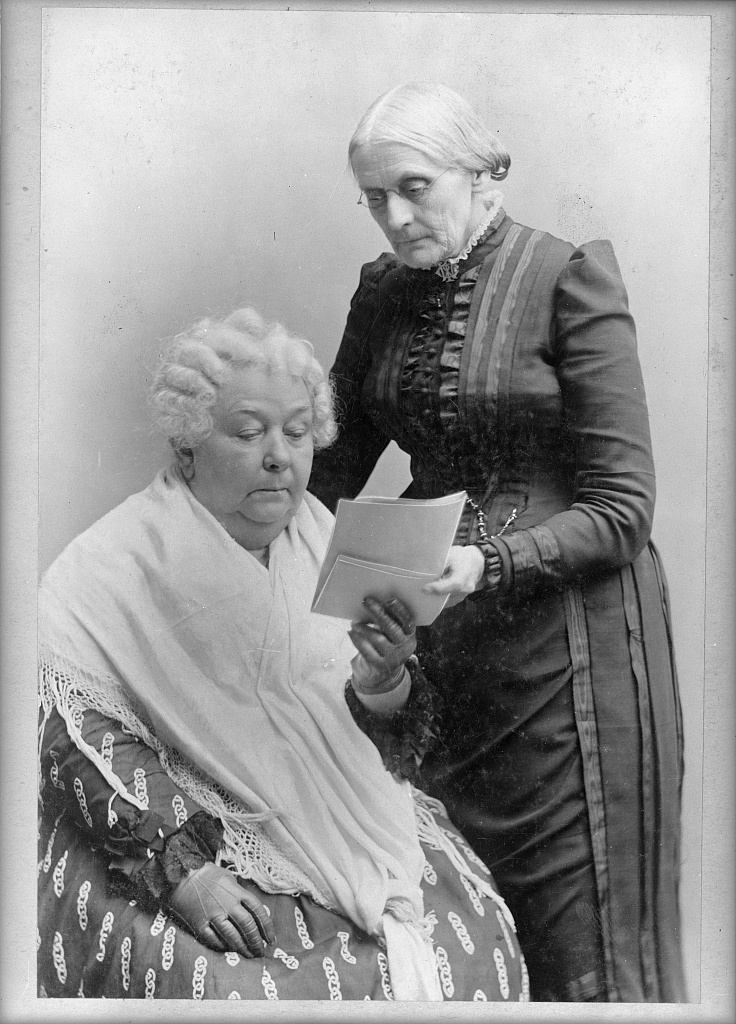
Elizabeth Cady Stanton, seated, and Susan B. Anthony, standing, three-quarter length portrait. , None. [Between 1880 and 1902] [Photograph] Retrieved from the Library of Congress, https://www.loc.gov/item/97500087/.
Elizabeth and Susan helped create the most powerful organization on woman suffrage during their time. Along with other women, they created the AERA, the American Equal Rights Association. During this time, Elizabeth and Susan argued that if anyone was deserving the right to vote, it was “educated” white women. Their downfall and AERA’s downfall was their third annual meeting where they were called out on their racist and offensive language by Frederick Douglass.
Questions
- These two women are the most commonly taught figures in the women’s suffrage movement. Why do you think they are often talked about, despite their racist and offensive language?
- Why do you think many Black people who supported the women’s suffrage movement, such as Fredrick Doulas and Sojourner Truth, are typically left out of history?
- Do you think the white women leaders of the AERA should have advocated for the rights of Black and white women and Black men, regardless of education levels? Why?
6. Alice Paul
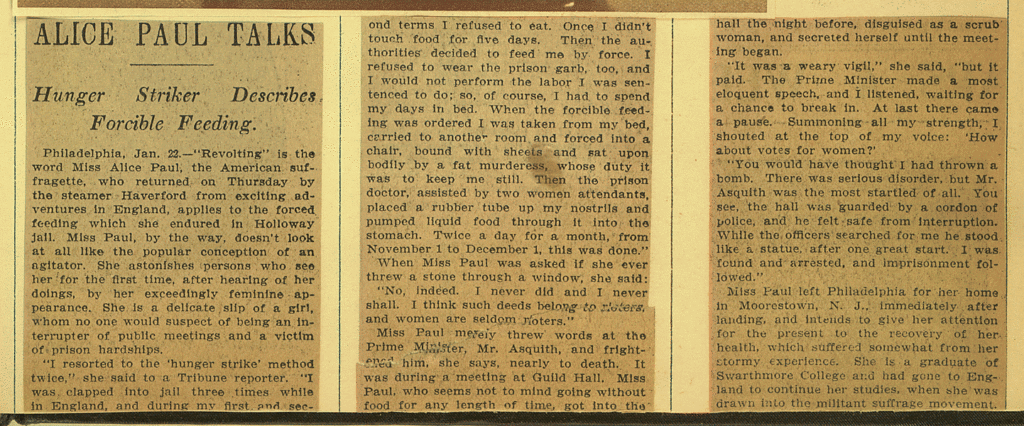
(1910) Alice Paul Talks. Philadelphia Tribune, Philadelphia, Pennsylvania, Jan-10. [Manuscript/Mixed Material] Retrieved from the Library of Congress, https://www.loc.gov/item/rbcmiller003903/.
Alice Paul, a 28-year-old from New Jersey arrived at the National American Woman Suffrage Association’s annual convention in Philadelphia. She had been arrested repeatedly, been imprisoned, gone on hunger strike (a prolonged refusal to eat), and been forcibly fed. She asked to organize the suffrage parade on March 3rd
Questions
- Why do you think Alice went on hunger strike?
- In the article, Alice talks about her time during imprisonment. What are some things that officers did to her during this time? Do you think what the officers did was right?
- Why do you think Alice went to such great lengths to fight for women’s rights? Would you do things she explained in the article to fight for your rights?
7. Woman’s Suffrage Parade, March, 1913
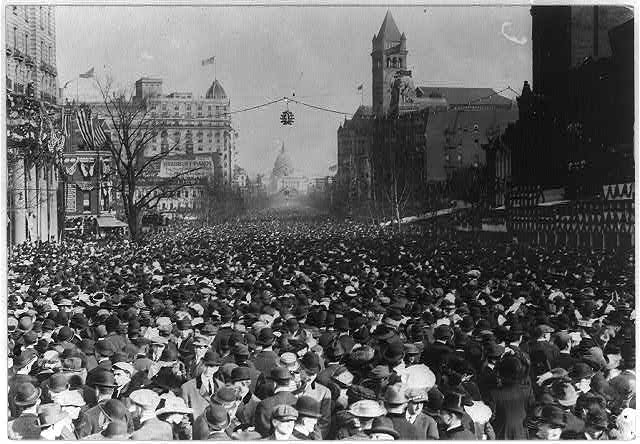
(1913) Woman's suffrage parade, Wash., D.C. Mar. , 1913. March. [Photograph] Retrieved from the Library of Congress, https://www.loc.gov/item/2002736824/.
When Alice Paul and Lucy Burns returned to the United States after working with the radical wing of the British Suffrage Movement, they wanted to include techniques and strategies that had been successful in other countries. They gathered 5,000 women for a suffrage parade on the eve of President-elect Woodrow Wilson’s inauguration.
Questions
- What do you think some of their strategies were? Think about Alice and what she did during her time in the British Suffrage Movement.
- Why would they form a protest on the eve of President-elect Woodrow Wilson’s inauguration?
- How do you think they got the word out about the protest?
Teaching Resources
- Elizabeth Leads the Way
- Author: Tanya Lee Stone
- Illustrator: Rebecca Gibbon
- Link to publisher website: https://us.macmillan.com/books/9780312602369/elizabethleadstheway
- Lifting as We Climb: Black Women’s Battle for the Ballot Box
- Author: Evette Dionne
- Link to publisher website: https://www.penguinrandomhouse.com/books/598796/lifting-as-we-climb-by-evette-dionne/
- Ida B. Wells: Let the Truth be Told
- Author: Walter Dean Myers
- Illustrator: Bonnie Christensen
- Link to publisher website: https://www.harpercollins.com/products/ida-b-wells-walter-dean-myers?variant=32117641084962
